
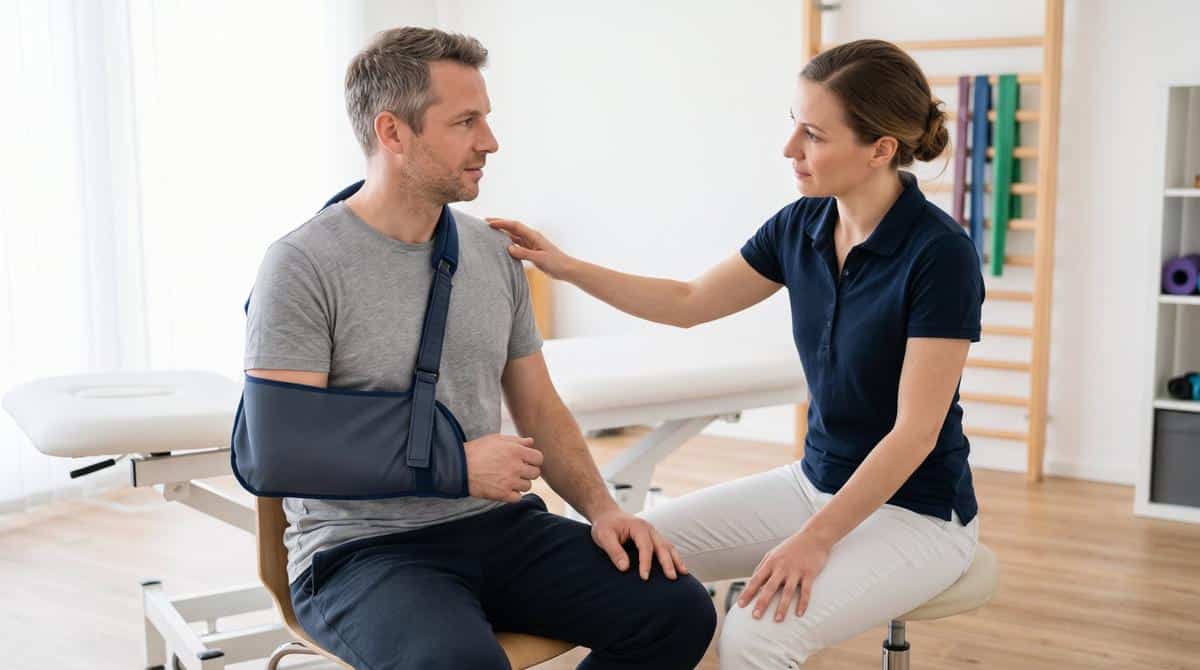
Rib fracture: Physiotherapist advises a patient with an arm sling

A fall on a bike, with a snowboard, or during football, and the arm is hardly able to be raised before the pain becomes unbearable: Who has experienced this? Ribs broken has usually fallen directly onto the shoulder or outstretched arm. The collarbone (clavicle) connects the sternum and the shoulder blade and holds the shoulder in position. It is one of the bones that are particularly prone to breaking in falls.

Most skull fracture injuries heal well. However, after weeks with an arm brace, the shoulder and neck often become stiff and the arm becomes weak. In our practice in Zürich-Wipkingen, we help you safely regain mobility and strength.

Symptoms: How do you recognize a broken collarbone?

  • severe pain in the collarbone, especially when moving the arm
  • Swelling and bleeding over the bone
  • Visible or palpable bump or bulge on the collarbone
  • the shoulder hangs forward and down
  • They involuntarily hold the arm with the other hand.

When should you see a doctor?

After a fall with these symptoms, you should have yourself examined by a doctor. An X-ray image shows where the collarbone is broken and whether the broken bones are displaced.

Go to the emergency room immediately if the skin over the fracture is severely tense or injured, if the arm or hand tingle, become numb or cold, or if you have difficulty breathing.

How long does the healing process take if the collarbone is broken?

Many fractures of the collarbone are treated without surgery. The arm is then supported in a sling for several weeks. If the broken bones are severely displaced or shortened, surgery is often performed and the bone is stabilized with a plate or a nail. After that, the shoulder can often be moved more quickly.

In adults, the bone usually takes six to twelve weeks to heal completely. During this time, restrictions often apply, such as not lifting the arm above the shoulder or carrying anything heavy. Your doctor will determine what is allowed. It usually takes several months before full strength for sports or physical work returns.

Self-help: What you can do yourself

If the collarbone is broken, you can support the healing with these tips:

  • Moving the hand and elbow: Open and close your hand and bend and stretch your elbow several times a day.
  • Cooling: In the first few days, short cooling helps with pain and swelling; never apply ice directly to the skin.
  • Getting a good night's sleep: Many people initially sleep better with their legs slightly raised, for example with several pillows on their backs.
  • Pay attention to posture: Do not let your shoulders drop forward permanently. This relieves the strain on your neck and shoulders.
  • Comply with specifications: Only lift and carry as much as is allowed.

Treatment in Physiotherapy
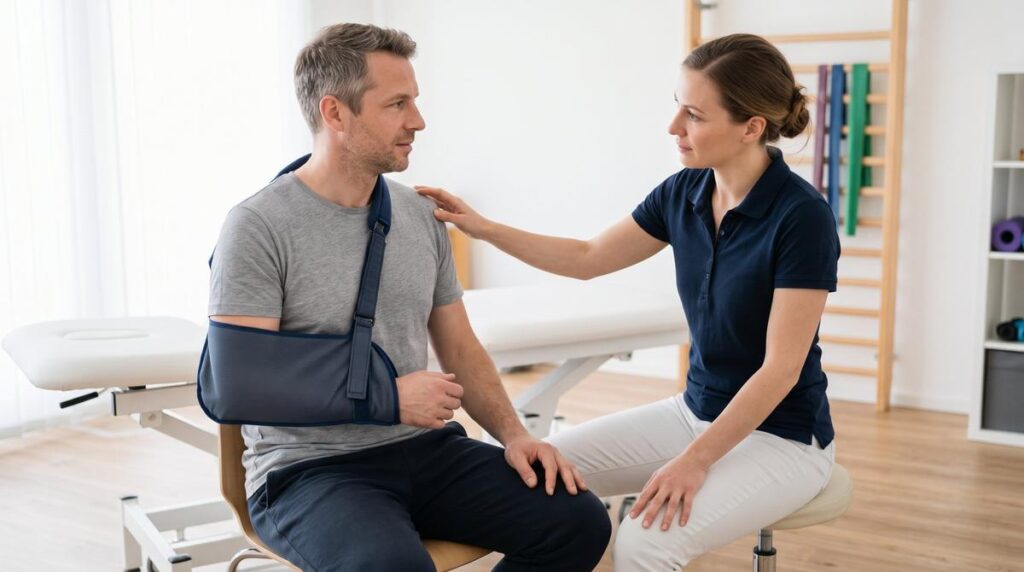
Rib fracture: Physiotherapist advises a patient with an arm sling

We examine the mobility, strength, and posture of the shoulder, shoulder blade, and neck and adjust the therapy according to the recommendations of your doctor:

  • Flexibility: Gradual mobilization of the shoulder with manual therapy and guided exercises
  • Shoulder blade and posture: Training the muscles that stabilize the shoulder blade so that the shoulder can function properly again
  • Relieve neck pain: Treatment of strains caused by restraint, for example with Dry needling
  • Building strength: Targeted strength building when the bone is capable of bearing weight. With the Power measurement see your progress.
  • Back to sports: We specifically build in loads such as supports, throws, or push-ups.

After a fall on the shoulder, the joint itself can also be injured. More about this in the articles Shoulder dislocation and Tendon tear in the shoulder.

Rib fracture: What the studies show

  • Operation or a noose: According to the Cochrane review Lenza et al. 2019 Surgery on fractures in the middle third of the femoral neck on average does not result in better results in function, pain, and quality of life than treatment without surgery. However, after surgery it is somewhat more rare for the fracture not to heal properly. However, the study quality is low, so an individual decision is made.
  • Which loop is the best? Whether a simple arm sling or a backpack bandage is better can be determined according to another Cochrane review (Lenza et al. 2016) I won't say yet. Choose with your doctor what is more comfortable for you.

For you, this means that whether you undergo surgery or not, the key to everyday life is a gradual mobilization and targeted strengthening of the shoulder and shoulder blade.

Rib fracture: Who pays for the physiotherapy?

For physiotherapy, you need a medical prescription. A fall is considered an accident. If you are accident-insured through your employer, the accident insurance usually covers the prescribed physiotherapy in full, without a deductible or co-payment. We directly settle with the insurance company. All details can be found on our page. Physiotherapy after an accident in Zurich.

Frequently asked questions about the broken collarbone

Does a lump remain after a fracture of the collarbone?

Often a small thickening forms at the fracture site because the bone is growing new tissue there. Over time, it usually becomes smaller and does not usually cause any problems.

When can I start riding my bike again?

Only when the bone has healed properly and you can hold the handlebars securely and brake firmly. Discuss the timing with your doctor.

When does the physiotherapy start?

Often already in the first weeks with gentle exercises for the hands, elbows and shoulders. How much is allowed depends on the treatment.

Make an appointment

Did you break your collarbone? We can help you get your shoulder and arm back into full use.

Our practice is located at Hönggerstrasse 118 in Zürich-Wipkingen, directly at the Waidfussweg tram stop (tram 50). Bring your medical prescription to the first appointment and, in the event of an accident, bring the damage number of your insurance company with you. Call us on 044 585 99 49 or Book your appointment online.

Sources

  • Lenza M et al. (2019): Surgical versus conservative interventions for treating fractures of the middle third of the clavicle. Cochrane Database Syst Rev. PubMed
  • Lenza M et al. (2016): Conservative interventions for treating middle third clavicle fractures in adolescents and adults. Cochrane Database Syst Rev. PubMed