
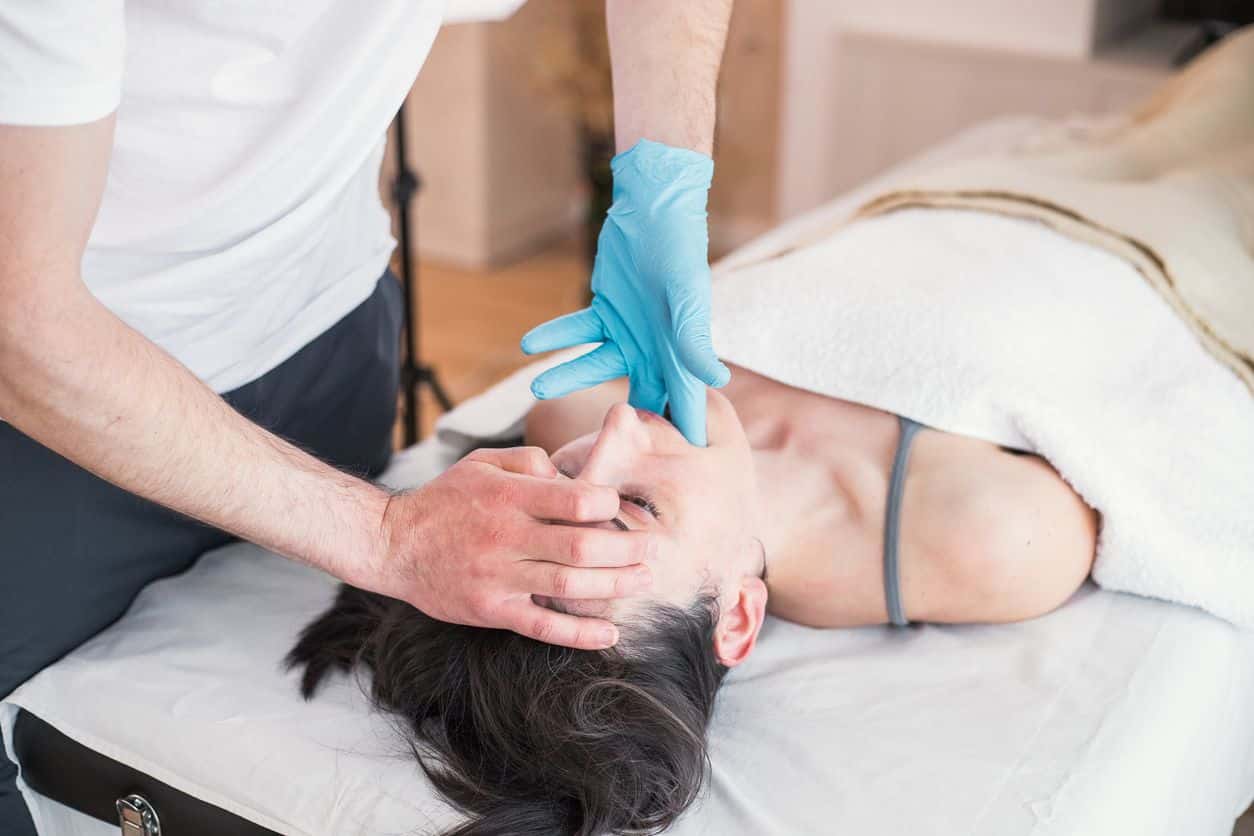
How to recognize when you grind your teeth
Most people who suffer from it snore at night and don't even notice it. Typical signs are:
- Tense or painful jaw muscles upon waking, sometimes a feeling as if you had been chewing all night
- Headaches in the temples or behind the eyes, especially in the morning
- Knocking or rubbing in the jaw joint, restricted mouth opening
- Sensitive teeth, sharp-edged teeth or small cracks in the tooth enamel
- Ear pain or pressure in the ear without a diagnosis from the ENT doctor, sometimes tinnitus
- Neck and shoulder tension that keeps coming back
- Imprints of the teeth on the edge of the tongue or on the inside of the cheek
Many people clench their teeth together even during the day without noticing: when working intently on a computer screen, in traffic jams, or during sports. This clenching is just as taxing on the muscles as the nighttime grinding.
Why we clench our teeth
Tooth clenching rarely has a single cause. Stress and internal tension almost always play a role; the jaw is one of the places where the body releases pressure. In addition, forward head positioning at the desk permanently puts the jaw under tension, as do tension and trigger points in the jaw muscles and neck, tooth or bite changes after dental treatments, restless sleep, and coffee, alcohol, and nicotine in the evening. Often, these factors reinforce each other: stress leads to tension, which leads to pain, which leads to poor sleep and even more tooth clenching.
In the long term, teeth grinding can trigger craniomandibular dysfunction (CMD), a functional disorder of the jaw joint that can lead to headaches, neck pain and even back pain. Read more about it on our page on Jaw joint therapy in Zürich Wipkingen.
What you can do yourself to stop teeth grinding
With a few simple habits, you take a lot of tension out of the calf muscles in everyday life:
- Check the resting position: With your lips closed, your teeth apart, and the tip of your tongue behind your upper front teeth. Check this position several times a day, for example every time you look at the clock.
- Massage the calf muscles: Place the fingertips on the sides of your cheeks and bite down briefly. You will feel the jaw muscle there. Massage it for one to two minutes with small circles, morning and evening.
- Warmth in the evening: A warm cherry-seed pillow or a warm washcloth on the cheeks and neck relaxes the muscles before bed.
- Reduce chewing: Chewing gum, hard breadcrumbs and nail biting also put additional strain on the jaw.
- Screen holding: Monitor at eye level, chin slightly back, shoulders relaxed. A head pushed forward activates the jaw muscles.
- Evening routine: Less caffeine and alcohol in the evening, a few minutes of conscious breathing or a short walk help the body wind down before bed.
When should you see a doctor or dentist?
Check with your dentist if your teeth are visibly worn down or sensitive, if your mouth no longer opens completely, or if your jaw joint is blocked; if you have headaches or earaches that last for weeks; or if you wake up with jaw or tooth pain every morning. The dentist will examine your teeth and bite and, if necessary, fit an upper arch brace that protects the teeth at night. However, the brace only protects the teeth; muscle tension remains. That is why dentists often recommend additional physiotherapy and issue a prescription for it.
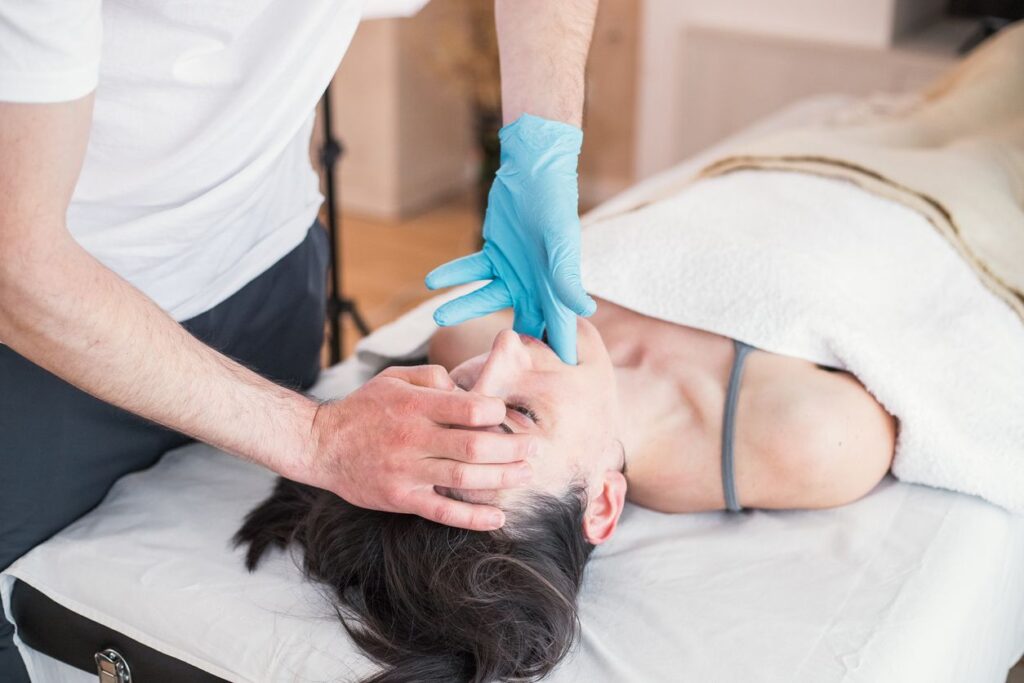
This is how we treat teeth grinding in physiotherapy
At the beginning, we examine the temporomandibular joint, the temporomandibular muscles, the cervical spine, and posture, because the cause is rarely just in the jaw. This forms your personal treatment plan, which usually combines several components:
- Manual therapy of the jaw joint and the cervical spine: Mobilization of the joint and the upper cervical vertebrae to restore freedom of movement and symmetry. More about this on our page Manual therapy.
- Trigger point therapy and dry needling: The masseter muscles (masseter muscles) and the deep masseter muscles in the oral cavity develop persistent trigger points when pinched, which can cause headaches, toothache and earache. We relieve them with Trigger point therapy and, where appropriate, with Dry needling.
- Relaxation and coordination exercises: You learn to find the resting position of the jaw, to consciously release the jaw muscles and to keep the mouth open straight.
- Posture and neck: Strengthening the deep neck muscles and adapting the workplace so that the head does not constantly hang forward. We explain in the article how closely the jaw and neck are connected. CMD Physiotherapy for headaches at the desk.
- Warmth and self-management: You get a small program for at home so that the tension between the appointments does not build up again.
With a medical or dental prescription, we will bill the treatment directly to your health insurance company. If the clicking is a result of an accident, for example after a blow to the jaw, the accident insurance will usually cover the costs. It is also possible to undergo treatment on your own account.
Frequently asked questions about teeth grinding
Does physiotherapy really help with teeth grinding?
Physiotherapy reduces the tension in the temporomandibular joint, improves the mobility of the jaw joint and alleviates the resulting pain in the head and neck. The nocturnal clicking itself is often less frequent as a result, especially if you incorporate the relaxation exercises into your daily routine. A dental splint protects the teeth, and physiotherapy relieves the muscles; both complement each other.
How many treatments do I need?
It depends on how long the symptoms have persisted. Many patients feel a significant relief after two to three treatments. For lasting change, six to nine sessions combined with your home program are usually advisable.
Can teeth grinding cause headaches?
Yes. The temporal muscle is a cranial muscle. When it is overloaded, it radiates out to the temples and forehead, which feels like tension headaches. Read more about this in the article. Migraine, headaches and jaw pain.
Do I need a regulation?
For billing to the health insurance company, you need a prescription from your doctor, dentist, or midwife. If your dentist notices any signs of gum inflammation, talk to them directly.
Tired jaw, heavy head? We can help you
If you wake up in the morning with a tight jaw or your dentist has noticed that you grind your teeth, Book an appointment online or call us at 044 585 99 49. Physio Waidfuss, Hönggerstrasse 118, 8037 Zürich Wipkingen, easily accessible from Höngg and the entire 10th district.

Tooth Grinding: Causes, Symptoms and How Physiotherapy Helps
Most people only notice teeth grinding when the dentist spots jagged edges or their partner notices it at night…
Read more
Headaches at your desk? How our CMD physiotherapy in Wipkingen helps
Headaches at the desk? How our CMD Physiotherapy Zurich Wipkingen helps Know what that is? It’s 3pm, you’re in a meeting…
Read more
Headaches - What to do? Causes and solutions
Who is affected by headaches? Headaches are a widespread phenomenon that affects people worldwide....
Read more
Migraine headache jaw pain
Headaches manifest themselves in everyday life and can make us feel completely unwell. We are on migraine in...
Read more