


After the ankle injury
The first step after an ankle sprain
A sprained or twisted foot can be very painful. However, with the right post-treatment, you can quickly get back on your feet. Did you know that relapses after a sprain are common and that a significant proportion of those affected develop chronic instability in the ankle? Therefore, it is worth training early and specifically.
Your support from physiotherapy
Our physiotherapy aims to get you back to your everyday life safely and quickly. We also want to ensure that you are soon active again and prevent future injuries and chronic instabilities. This is because persistent instabilities increase the risk of Osteoarthritis in the ankle joint.
Our therapeutic approach is individually adapted to your healing phases. In the initial phase, we offer you strategies for everyday life to avoid strain. In the following sessions, we increase the load in a controlled manner - the training begins! As a rule, after 4-8 weeks (or 8-12 weeks in the case of more serious injuries) you will reach the same level of function as before the injury.
What exactly is an ankle sprain?
An ankle sprain, also known as an OSG (over-the-ankle injury), can have various degrees of severity, ranging from a tear in the ligaments and muscles to a complete rupture. Most often, the anterior, outer side ligament (ligamentum fibulotalare anterius) is affected. With the right post-treatment, affected individuals often have a good chance of a complete recovery. However, particularly severe cases, in which the posterior outer ligament or other structures are also affected, may require longer rehabilitation periods.
Typical symptoms of a sprained ankle
- Swelling and bleeding at the outer ankle
- Painful and pressure pain
- Feeling of instability upon onset
- restricted mobility in the ankle joint
Sprain of the ankle: What the studies show
- Training instead of rest: The European guideline recommends using tape or a splint combined with a supervised exercise program after a ligament injury in the ankle – active training is preferable to passive measures (Vuurberg 2018).
- Starting early is worth it: In a randomized study, an accelerated exercise program improved the function of the ankle joint in the first week (Bleakley 2010).
- Prevent relapses: Home balance training after conventional treatment reduced the risk of a recurrence of sprains by 35% (Hupperets 2009). A review of 46 reviews found strong evidence for taping and moderate evidence for neuromuscular training for prevention (Doherty 2017).
- Take chronic instability seriously: Recurrences are common and can lead to chronic instability, which is associated with less movement, a lower quality of life, and more osteoarthritis (Gribble 2016). Those who fail the jumping and landing tests two weeks after the injury have a higher risk of it (Doherty 2016).
- Medication: Anti-inflammatory agents provide short-term relief of pain and swelling (van den Bekerom 2015), but should be used sparingly according to the guidelines.
Self-help: What to do in the event of a sprained ankle?
The PECH rule used to be recommended: Rest, ice, compression and elevation. Nowadays, however, the most modern treatment is based on the PEACE and LOVE principle:
- Protection: Avoid painful movements in the first few days after the injury.
- Elevation: Raise the leg as often as possible, ideally above heart level.
- Avoid anti-inflammatories: Be cautious with anti-inflammatory medications. They can provide short-term relief from pain and swelling, but may potentially hamper the body’s natural healing process. Discuss their use with your doctor.
- Compression: Use compression bandages or tapes to reduce swelling.
- Education: Anyone who understands what is happening in the tissue can actively contribute to recovery. We place great emphasis on educating you.
- Load: Later in the healing process, it is important to increase the load in a targeted manner, always in harmony with your pain sensation.
- Optimism: A positive attitude promotes the healing process.
- Vascularization: Pain-free activities such as cycling or swimming support healing.
- Exercise: Physiotherapy helps you to regain strength and mobility through targeted exercises.
Conservative therapy versus surgery
In most cases, conservative therapy has advantages over surgery – shorter rehabilitation times and fewer complications are just some of them. Surgical interventions are usually only necessary in severe trauma (Grade 3) or additional bone fractures. A Cochrane review found no robust benefit of surgery: Those who underwent surgery needed longer to recover, often had a stiff ankle joint and more complications. The European guideline therefore recommends first a consistent exercise program and only surgery if this is not sufficient.
Walking the path to recovery together
Let us work together on your recovery! Trust our expertise and our tried and tested treatment methods. Whether you're a jogger, recreational badminton player or tennis enthusiast - we'll help you get back to your favorite sport soon, pain-free and full of energy.
Your path back to mobility starts here!
Your motivational guide after an ankle sprain
An ankle sprain is not the end, but the beginning of a new, challenging chapter. Whether you've been injured while running, on the badminton or tennis court, or during another sporting activity, the good news is that you can come back stronger than ever. The journey of recovery may be tough, but each stage along the way brings you closer to your comeback.
The first stage is to accept the injury and prepare yourself mentally. The ankle sprain is your new challenge, and with the right attitude you can overcome it. Every small improvement is a step in the right direction.
Patience and continuity are crucial. Sporting success does not happen overnight and the same applies to healing an ankle sprain. Follow your rehabilitation plan with discipline and consistency. The road back to your normal activities starts here and now.
Our physiotherapy is not only focused on your physical recovery, but also on giving you mental support. Through targeted exercises and individual support, every session becomes an opportunity to get closer to your sporting comeback.
Use the rehabilitation period to build an even stronger foundation. Strengthen your weak points and improve your overall fitness to not only return to your previous level of performance, but even surpass it.
Let your family, friends and team motivate and support you. The shared joy of progress and shared strength are invaluable assets on your journey of recovery and return to sport.
An ankle sprain may be challenging, but remember: your comeback starts today. Trust in your body, your mental strength and the support of those around you. Together we can do it!
When should you see a doctor or go to physical therapy?
Seek medical attention promptly if you are unable to bear weight on the leg at all, if there is a visible deformity, if the swelling is very severe, or if the joint feels unstable (repeated "winking out"). Only in this way can a ligament tear or a bony rupture be ruled out with certainty. An X-ray is advisable according to the Ottawa rules if you cannot walk for four steps immediately after the accident or if the bone on the back edge or tip of the outer or inner ankle hurts on pressure. These rules very reliably rule out a fracture.
For the targeted establishment of stability after the acute phase, we recommend our Manual therapy in combination with individual coordination training.
In addition to mobilization, we sometimes use the following techniques for ankle sprains: Flossing therapy one, to improve mobility. The research evidence on this is still limited – the core of the treatment remains active training.
Book an appointment online now
After an accident? Information on the cost coverage by the Accident Insurance (UVG) and on the course of therapy can be found on our page. Physiotherapy after an accident in Zurich.
If a dispute involves more than just a ligament being injured, but the ankle being broken, read our article. Ankle broken.
Sources
- Vuurberg G et al. Diagnosis, treatment and prevention of ankle sprains: update of an evidence-based clinical guideline. Br J Sports Med 2018
- Bleakley CM et al. Effect of accelerated rehabilitation on function after ankle sprain: randomized controlled trial. BMJ 2010
- Hupperets MD et al. Effect of unsupervised home-based proprioceptive training on recurrences of ankle sprain. BMJ 2009
- Doherty C et al. Treatment and prevention of acute and recurrent ankle sprain: an overview of systematic reviews with meta-analysis. Br J Sports Med 2017
- Gribble PA et al. Evidence review for the 2016 International Ankle Consortium consensus statement. Br J Sports Med 2016
- Doherty C et al. Recovery from a first-time lateral ankle sprain and the predictors of chronic ankle instability. Am J Sports Med 2016
- Kerkhoffs GM et al. Surgical versus conservative treatment for acute injuries of the lateral ligament complex of the ankle in adults. Cochrane 2007
- van den Bekerom MPJ et al. NSAIDs for treating acute ankle sprains in adults. J Athl Train 2015
- Bachmann LM et al. Accuracy of the Ottawa ankle rules to exclude fractures of the ankle and mid-foot. BMJ 2003
- Dubois B, Esculier JF. Soft-tissue injuries simply need PEACE and LOVE. Br J Sports Med 2020

Morton Neuroma: Symptoms, Causes and Treatment
Burning between the toes? Symptoms, causes, and treatment in a Morton neuroma.
Read more
Fractured midfoot bone: symptoms, healing and physiotherapy
How to recognize a midfoot fracture, how long the healing process takes, and how physiotherapy affects walking and endurance…
Read more
Ankle fracture: healing, load bearing and physiotherapy
How to heal a broken ankle, when you can resume activities and how physical therapy improves walking, strength and stability…
Read more
Stubborn heel pain: heel spur or plantar fasciitis?
For many sufferers, the day begins with a nasty surprise: You get out of bed, strain your foot and…
Read more
Sprained foot
Holistic treatment of ankle sprains: Effectively counteracting sprains of the foot Ankle sprains,...
Read more
Stretching program
Your stretching program Stretching is an essential foundation for your mobility and well-being.
Read more
Sprained ankle – Causes, Treatment and Tips for Healing
The way back to sport after an ankle sprain Whether during an intensive game of basketball, jogging on uneven ground or...
Read more
Achilles pain? These methods really help
Achilles tendon pain: Causes, symptoms and what really helps Achilles tendon pain affects especially people who are…
Read more
Flossing during scar treatment: What it can and cannot do
Have you ever heard of flossing? This innovative physiotherapy technique is becoming increasingly popular,...
Read more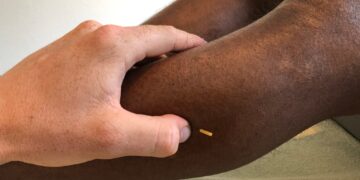
Dry needling explained: when and why it helps
Effect of Dry Needling: This is how the needle helps with muscle pain. When using Dry Needling, we use fine needles to target specific…
Read more