
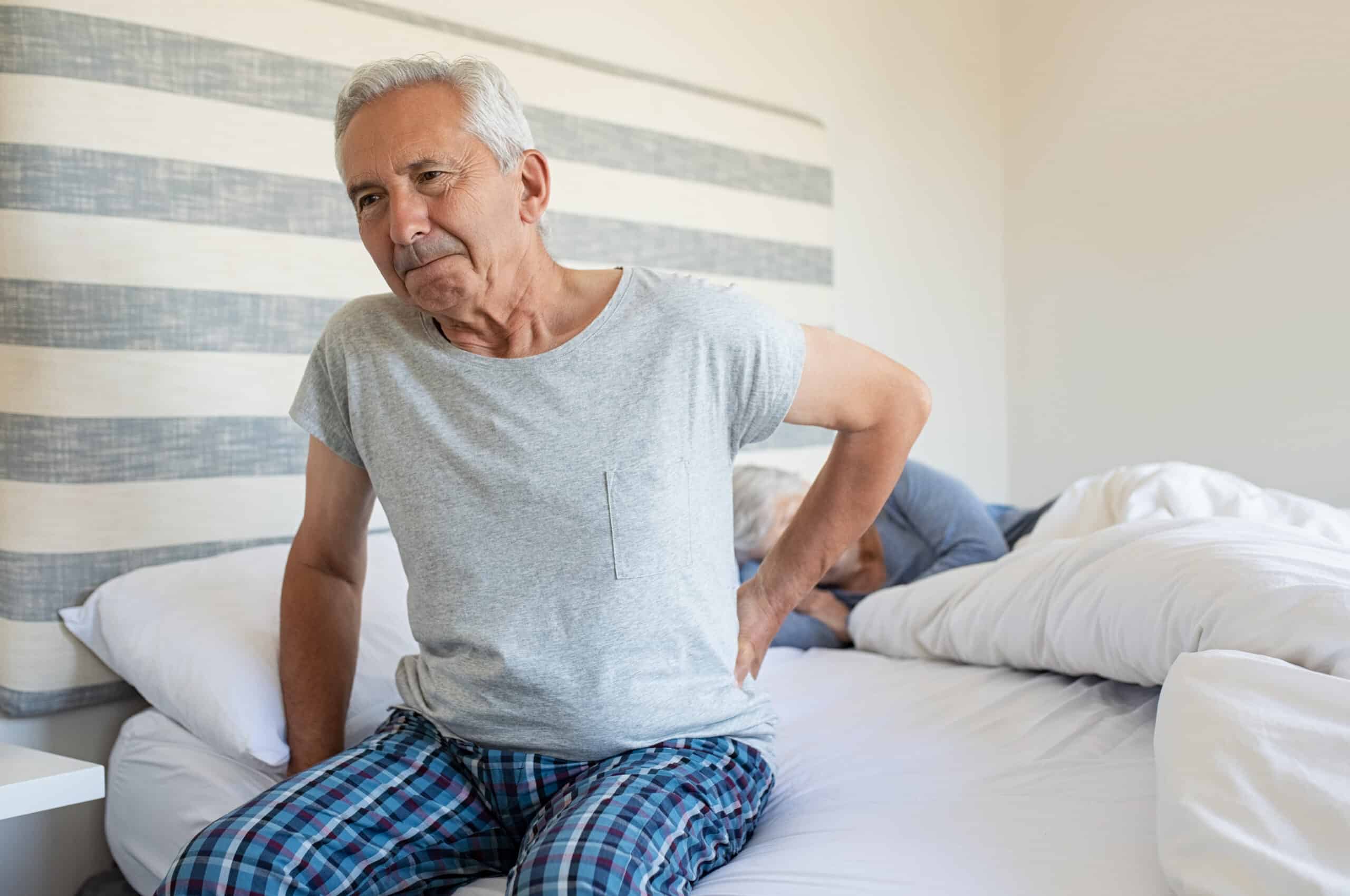
Back pain 60+
What really changes with back pain as you age?
- Intervertebral discs lose elasticity: You will become thinner, which makes the spine somewhat more compact and can restrict mobility.
- Muscle mass decreases (sarcopenia): Less muscle strength means less spinal stability – a cycle that intensifies without intervention.
- Bone density changes Especially with osteoporosis, the risk of painful vertebral body changes increases.
- Spinal joints change: Arthritis-like changes in the small vertebral joints can cause localized pain.


The key is that muscles and mobility can be trained at any age. This is precisely where physiotherapy comes in. Those who understand these changes often lose their fear of movement – a feeling that initially accompanies many older people with back pain, even though targeted movement is exactly what benefits the spine.
Typical symptoms of back pain in old age
Often, a dull, aching pain in the lower back is present, which is particularly pronounced in the morning after waking up and improves with movement. There may also be increasing stiffness, limited mobility, or a feeling of instability when walking.
Our approach at Physio Waidfuss for back pain in those 60+
- Thorough examination: We differentiate whether the pain is muscular, joint-related, or partly due to changes like osteoporosis – this directly influences the treatment.
- Strength training adapted to your pace: Targeted exercises for core and back muscles that provide stability without overexertion.
- Agility training: Gentle spinal mobilization to make everyday movements like bending, twisting, or standing up easier.
- Fall prevention as a side effect: A strong back and trained balance simultaneously reduce the risk of falls in everyday life.
- Practical advice: How to make gardening, carrying shopping bags, or prolonged sitting more comfortable for your back.
When should you pay closer attention to your back pain as you age?
Some warning signs should not be dismissed as being "just old age"; they should be evaluated by a doctor: sudden onset of very severe pain, noticeable loss of strength in the legs, numbness, or unintended weight loss. In the vast majority of cases, back pain in old age is well treatable with physiotherapy. Detailed background information on osteoporosis as a possible contributing factor can be found at Rheumatism League Switzerland.
What the research says about back pain in old age
- Very common, but not fate: According to the Global Burden of Disease study (GBD 2021 Low Back Pain Collaborators, 2023In 2020, 619 million people worldwide suffered from back pain. By 2050, 843 million are expected to suffer from it, partly because the population is getting older. Back pain in old age is therefore common, but not a reason to resign yourself to it.
- Training works: The Cochrane review of Hayden et al. 2021 With 249 studies, it shows that exercise training is likely to reduce pain and limitations in chronic back pain compared to no treatment or usual care.
- Walking protects against falls: In the WalkBack study (Pocovi et al. 2024, The Lancet) With 701 adults (average age 54 years), an individual, step-by-step walking program combined with training increased the time until the next relapse almost twofold: on average 208 days instead of 112 days.
- Strength training despite osteoporosis: In the LIFTMOR study (Watson et al. 2018) Women who had undergone menopause and had low bone density trained for eight months twice a week with intensive, closely supervised strength training. Their bone density improved and no adverse events occurred. Important: The training was expertly guided and structured in stages. Therefore, it is best to have it performed by an experienced professional.
- No fear of bending over: An overview study (Saraceni et al. 2020) found no evidence that a rounded back causes back pain when lifting. However, the study quality is still limited.
For back pain in old age, this means exercise, strength, and regular walking are the most important components, and they still work even at the age of 70 or 80.
Self-help: Small everyday adjustments with great effect
In addition to physical therapy, some simple habits help prevent back pain in old age:
- Regular walks: Even 20 to 30 minutes of daily walking maintains the mobility and muscle tone of the back.
- Lift without fear: According to studies, there is no one right lifting technique. Carry loads close to your body, distribute heavy purchases over two bags, and increase weights gradually. A strong back is best suited for everyday tasks.
- Take sitting breaks: Sitting for extended periods without breaks often exacerbates back pain in older adults; regularly standing up counteracts this.
- Sufficient protein Nutrition plays a supportive role in maintaining muscle mass alongside training.
These habits do not replace targeted treatment, but they are a good addition in between appointments. Those who no longer feel comfortable going to the clinic can benefit from our mobile physiotherapy right at home.
Frequently Asked Questions About Back Pain in Older Adults in Zurich
Is it still worthwhile to train back muscles at 70 or 80? Yes, explicitly. Muscle building is possible at any age, even if it progresses more slowly than at 30. Adapted, regular training is crucial.
I have osteoporosis – can I still do physical therapy? Yes, even highly recommended. We tailor exercises so that they strengthen the bones without overloading them. Simply contact us directly if you have a known osteoporosis diagnosis.
Do I need a doctor's prescription for the treatment? With a regulation, the basic insurance covers the costs. However, you can also come directly to us as a self-payer without a regulation.
How quickly will I notice an improvement? For pain caused by muscle issues, improvements are often seen after just a few treatments. For structural changes like osteoporosis or osteoarthritis, it is more of a long-term but rewarding process.
Stay mobile, even in your back
Back pain in old age is not a reason to withdraw from society. Book an appointment online or come by at Physio Waidfuss in Wipkingen – our Team We will develop a program together with you that suits your daily routine and pace.
Sources
- GBD 2021 Low Back Pain Collaborators (2023): Global, regional, and national burden of low back pain, 1990–2020, and projections to 2050. Lancet Rheumatol. PubMed
- Hayden JA et al. (2021): Exercise therapy for chronic low back pain. Cochrane Database Syst Rev. PubMed
- Pocovi NC et al. (2024): Effectiveness and cost-effectiveness of an individualized, progressive walking and education intervention for the prevention of low back pain recurrence (WalkBack). Lancet. PubMed
- Watson SL et al. (2018): High-intensity resistance and impact training improves bone mineral density and physical function in postmenopausal women with osteopenia and osteoporosis: The LIFTMOR randomized controlled trial. J Bone Miner Res. PubMed
- Saraceni N et al. (2020): To Flex or Not to Flex? Is There a Relationship Between Lumbar Spine Flexion During Lifting and Low Back Pain? J Orthop Sports Phys Ther. PubMed

Trapped nerve: Symptoms, duration, and what really helps
Stinging, burning or tingling? What lies behind a pinched nerve, how long it takes and what really affects you...
Read more
Symphysis pain during pregnancy: What really helps?
Symphysis pain during pregnancy affects many women unexpectedly: a stabbing pain in the front of the thigh…
Read more
Spinal canal stenosis: When walking suddenly becomes a torture
What is a spinal canal stenosis? It is a gradual process that severely restricts everyday life: they make you…
Read more
Back pain during pregnancy in Zurich | Physio Waidfuss
Back pain during pregnancy: This is how physiotherapy in Wipkingen can help you…
Read more