
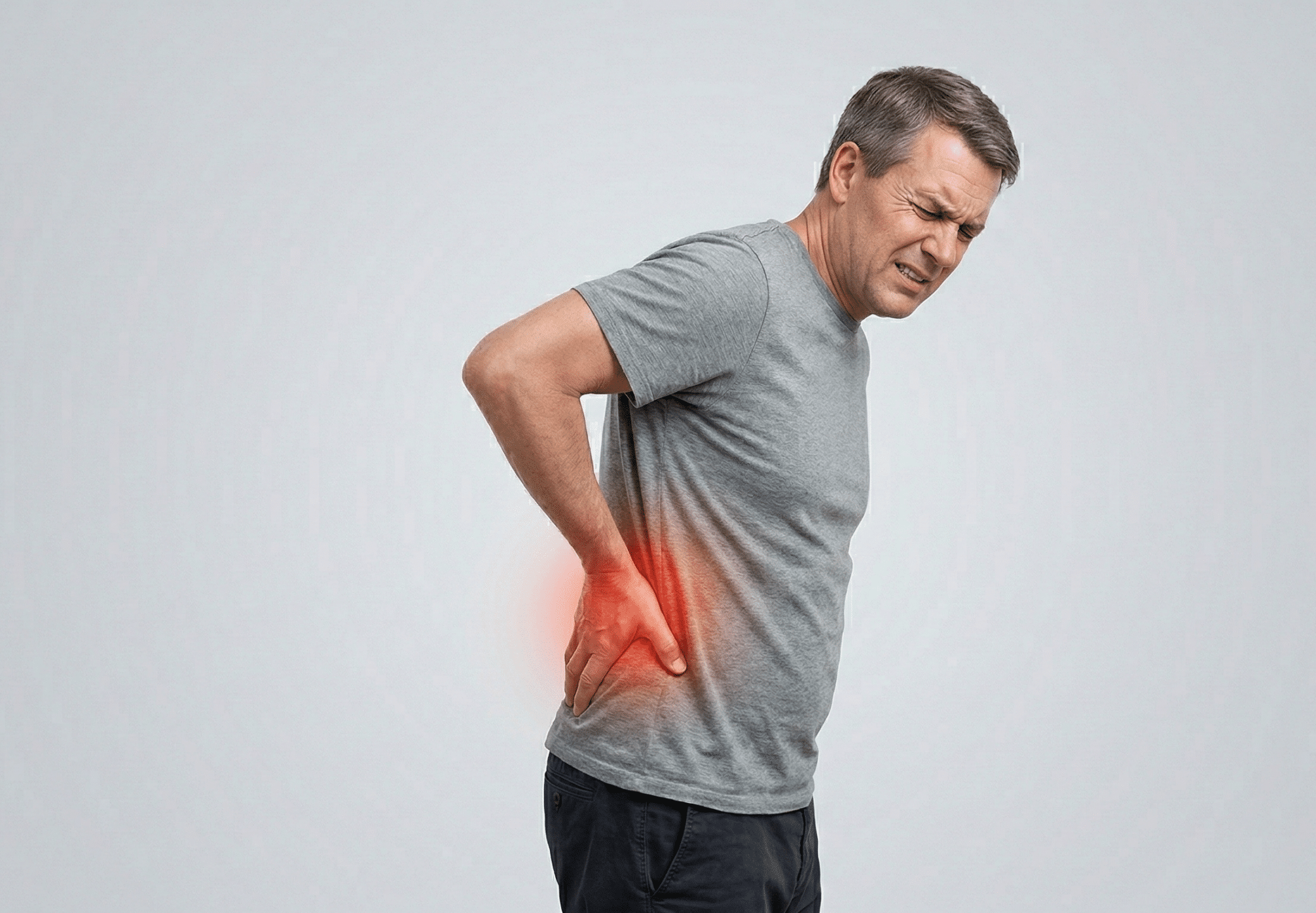


What happens with a disc hernia?
What happens with a disc hernia?
Imagine the disc as a dumpling (Berliner): On the outside, a solid fiber ring; on the inside, a soft gel core. In a Prolapse The ring tears apart, and the soft gel mass leaks out. The problem arises when this mass comes into contact with a nerve root that exits from the spinal cord there. Two factors work together in this process:
-
Mechanical pressure: The space for the nerve becomes tight.

-
Chemical irritation: The leaked disc material causes an inflammatory reaction on the nerve.
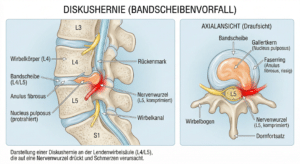
The consequences are the familiar symptoms: Radiating pain down the leg (sciatica), tingling („formication“) or numbness. The nervous system sounds the alarm because its „data highway“ is disrupted.
The body's superpower: spontaneous resorption
Why is surgery so rare today? Because the body often solves the problem itself. The immune system recognizes the leaked material as „foreign“. It sends scavenger cells to break down the tissue. The prolapse dries up, so to speak, and shrinks over time. Our task in physiotherapy is to bridge this period, alleviate the pain and help the nervous system to deal with the irritation.
Your treatment plan with us
„Simply strengthening the trunk“ is often too little or too early in the case of an acute incident. We work in a more specific and neuro-centered way:
1. nerve mobilization (neurodynamics) This is often the key to success that many people neglect. Nerves are not rigid wires, but must be able to glide with every movement. Due to the prolapse and inflammation, the nerve is often swollen or „stuck“ in the tissue. With gentle Nerve mobilization (neural gliding or flossing) we carefully move the nerve back and forth in its sheath without exerting aggressive traction.
-
This improves blood flow to the nerve.
-
It helps to remove inflammatory substances.
-
It signals to the brain: „The line is intact, movement is safe.“ This gentle mobilization often brings more relief than simply stretching the muscles.
2. the McKenzie concept (directional orientation) There is often a direction of movement that takes the pressure off the nerve root. This is often hyperextension (bending backwards) - the exact opposite of the instinctive protective posture (hunching over). If we achieve through repeated movements that the pain withdraws from the leg into the back (centralization), this is an excellent sign of healing and the reduction of irritation.
3. Functional stabilization Only when the nerve has calmed down and can glide do we start to build up resilience. But the same applies here: we are not training wild „six-pack training“, but rather fine control. The brain must learn to stabilize the spine safely and reflexively in everyday situations. We integrate breathing and posture to make the back resilient.
How long does the treatment take?
Treating a disc hernia is not a sprint. Nerve tissue heals more slowly than muscles. Count on 6 to 12 weeks for a significant improvement in symptoms. Complete tissue healing may take even longer, but you will be able to be active again much sooner.
The conservative approach is worthwhile: those who learn to do their nerves good through mobilization and to move physiologically correctly often have a healthier back in the long term than after a quick operation. Don't be afraid of the diagnosis. With the right strategy, we can get it under control.
Self-help: What you can do yourself in everyday life
-
Avoid prolonged, rigid sitting – change your position regularly.
-
Movement in the pain-free area (e.g., walking) supports healing, but complete rest does not.
-
When lifting and bending over, be mindful of using a posture that is gentle on the back (from the hips, close to the body).
When should you seek immediate medical attention?
Seek immediate medical attention if you experience numbness in the thigh area, problems urinating or defecating, sudden severe weakness in the leg, or sharply increasing radiating pain. These warning signs require immediate evaluation.
In addition to physiotherapy, our Manual therapy specifically aimed at mobilizing the spine.
Do you have questions about your diagnosis or are you suffering from acute symptoms? Make an appointment. We check how flexible your nervous system is and start the right therapy for your back.

Spinal canal stenosis: When walking suddenly becomes a torture
What is a spinal canal stenosis? It is a gradual process that severely restricts everyday life: they make you…
Read more
Back pain during pregnancy in Zurich | Physio Waidfuss
Back pain during pregnancy: This is how physiotherapy in Wipkingen can help you…
Read more
Back pain due to sports Zurich | Physio Waidfuss
Back pain from sports: When training instead of balance brings stress to the back Zürich: They…
Read more
The SI Joint Syndrome: Is it the disc or the pelvis?
SI joint syndrome The pain is extremely deep, almost in the buttocks, often radiates unilaterally into the thigh and is...
Read more
Acute lumbago sciatica Zurich – We treat you in Wipkingen
Back spasm and sciatica: When your back suddenly locks Up. A wrong step while getting out of the trampoline,...
Read more
Back Pain in Old Age Zurich | Physio Waidfuss Wipkingen
Back pain in old age: Why it's not "normal aging" "It's just from aging" – we hear this sentence...
Read more
Diagnosis of herniated disc (disc hernia)
Diagnosis of a herniated disc (disc hernia) - Why nerve mobilization often helps better than surgery For many patients...
Read more
Lumbago or lumbago (witch's shot)? What is the difference?
Lumbago or lumbago (Hexenschuss) – or „just" back pain? Back pain is by far the most common reason,...
Read more
Put an end to office back pain in Zurich Wipkingen
Put an end to office back pain Do you know what it's like? A long working day, lots of screen time - your neck gets...
Read more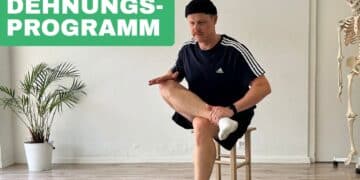
Stretching program
Your stretching program Stretching is an essential foundation for your mobility and well-being.
Read more
Workplace ergonomics - Do you work at a computer?
Ergonomics at the workplace: effective measures against back pain and neck tension You’re probably familiar with…
Read more
Back pain: understanding and solutions
Back pain: can have many causes Back pain is one of the most common complaints that affect people....
Read more
Lumbago - What really helps to relieve the pain
Lumbago - Understanding lower back pain: Important information for you Imagine you are lifting...
Read more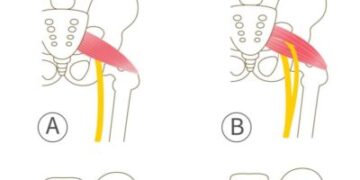
Piriformis syndrome - What helps against pain in the buttocks?
Piriformis syndrome and lumbago at a glance What is piriformis syndrome? Piriformis syndrome is a...
Read more
Back pain - causes, symptoms and treatment options
Back pain - causes, symptoms and treatment options Back pain is a widespread problem.
Read more