

How Balance is Achieved
The GPS of your body: How balance is created
Imagine your brain is like a navigation system. For it to safely guide you through space ("Go straight ahead, turn off the cruise control"), it needs perfect reception from three satellites:
-
Your eyes (visual system): Where is the horizon? Where is the obstacle?
-
To your inner ear (balance organ): Am I moving? Where is up and down?
-
To your sense of body (proprioception): How is my foot positioned? Is the ground hard or soft?
As we age, these signals become weaker. Our eyes become less sensitive, and our feet can sense less. The result: Our "navigator" has poor reception.
Typical symptoms of an increased risk of falls
- Uncertainty when walking on uneven ground or in the dark
- Feeling dizzy when getting up quickly or turning around
- Increasing caution, clinging to furniture, or increased stumbling
The Danger of "Fear Paralysis"
When the brain receives unsafe data, it presses the alarm button. It enters protective mode. This means: You become rigid. Your neck muscles tighten, your steps become small and lumbering.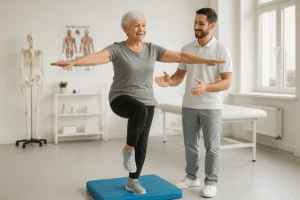
The paradox of it: This very stiffness increases the risk of falling. A rigid body can no longer absorb unevenness. If you then stumble, you cannot react smoothly.
At Physio Waidfuss, we work not only on your muscles, but also on your "software". We recalibrate your navigation system.
Why "Walking and Talking" is So Difficult (Dual-Tasking)
Have you ever noticed that some people have to stop when they want to talk while walking? That's a warning sign.
Walking should happen automatically. However, if your balance system weakens, your brain has to concentrate extremely hard to avoid falling over. If a "mental task" is added to that (having a conversation, watching the traffic), the processor is overloaded. The system crashes – and you fall over.
That's why we train with us Dual-TaskingWe train your brain to keep your body stable while you are thinking, looking, or speaking. This is the real fall prevention for everyday life.
Self-help: 3 neuro-tips that you can implement yourself
You can already start sharpening your system today. Here are three exercises from neurocentric training:
1. Loosen the "office eye" (Visual training)
Falls happen often because we overlook obstacles at the edge of our field of vision.
-
The exercise: Hold your thumb in front of you with your arm extended. Fix the thumb with your eyes. Now slowly turn your head to the left and right (as in "no"), but Her eyes remain fixed on the thumb.
-
The effect: This trains the so-called VOR reflex, which keeps your image stable when you move.
2. Waking the Feet (Proprioception)
Your feet are your sensors. In thick shoes they become "blind".
-
The exercise: Brush your teeth in bare feet on a rolled-up towel in the morning. The uneven surface forces your brain to contract the small foot muscles quickly.
3. Brain Jogging While Walking
-
The exercise: The next time you go for a walk, always subtract 7 from the number 100 (100, 93, 86...).
-
The effect: They force your brain to re-automate walking while you think.
Your way to more security in Zürich Wipkingen
Are you unsure on your feet? Are you afraid of the next winter or the hiking trip?
Let's find out what's causing it. Physio Waidfuss We test not only your strength, but also your eyes, your balance organ, and your reaction speed. We create a plan that not only makes you stronger, but also more competent.
It's never too late to teach your brain new tricks.
When should you have a medical or physical therapy consultation?
Not all uncertainty is harmless. Seek medical advice promptly from a doctor or our physical therapy service if:
-
You have already done this in the last 12 months fell down once or several times are.
-
Suddenly to you dizziness you will either lose consciousness or you will lose consciousness for a short time.
-
They are increasingly Uncertain when climbing stairs or feel on uneven ground.
-
New medications that can cause dizziness or drowsiness should be taken.
In these cases, it is worth conducting a targeted assessment of your risk of balance and falls before anything else happens.
In addition to individual therapy, we also offer balance and strength training. Small group training an ideal way to continue training regularly and cost-effectively.
Contact & Appointment
Would you like to have your risk of falling tested?
-
Call us: 044 585 99 49
-
Write to us: info@physio-waidfuss.ch
-
Visit us: Hönggerstrasse 118, 8037 Zurich
For people who are unable to come to the clinic after a fall, the clinic area also includes mobile physiotherapy at home possible.
Get your security back!

Storage dizziness (BPLS): Vestibular physiotherapy in cases of dizziness attacks
The room rotates even though you lie completely still. They rotate in the bed, and for a few seconds everything…
Read more
Fall Prevention & Balance Training Zurich | Physio Waidfuss
Fall prevention in old age: Why strength alone isn’t enough (And what your eyes have to do with it) Do you know that feeling?…
Read more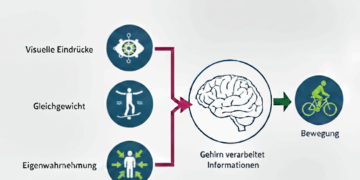
Neuro-focused training in physiotherapy
What is neuroathletic training (NAT)? Neuroathletic training (NAT) is a modern and holistic therapeutic approach...
Read more
Physiotherapy for seniors Zurich Wipkingen
Active and pain-free in old age: Our physiotherapy for seniors in Zurich Wipkingen helps with osteoarthritis, back pain...
Read more
Sprained foot
Holistic treatment of ankle sprains: Effectively counteracting sprains of the foot Ankle sprains,...
Read more
Knee pain – Why it occurs and how you can relieve it
Everything you need to know about knee pain: Causes and treatment options Knee pain is a common...
Read more