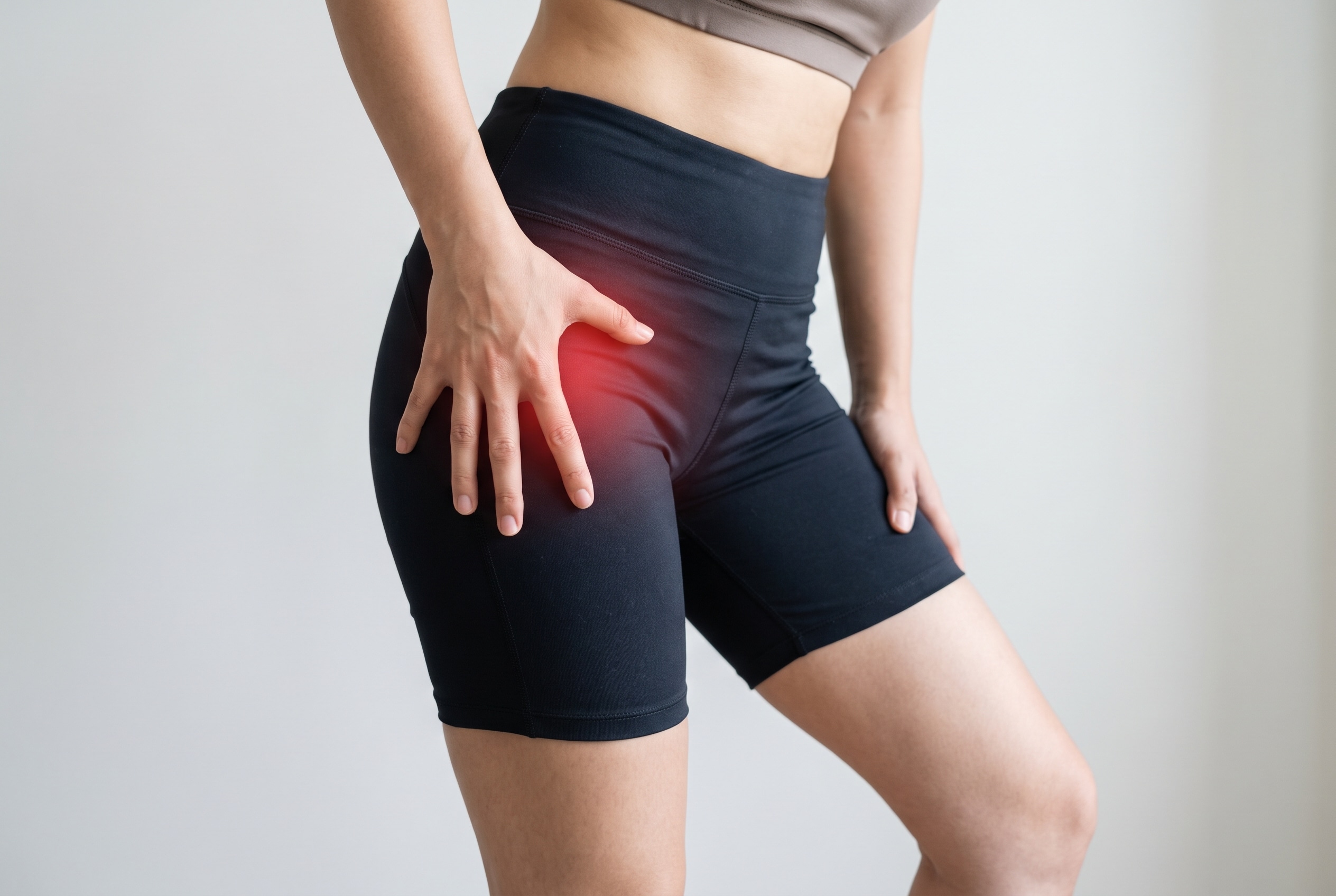
Common causes of groin pain
- Adductor overload: The muscles on the inner thigh are irritated or strained, typical in football, ice hockey and sprints.
- Hip joint: Inflammation in the hip joint (impingement) or wear and tear, see Hip joint arthrosis.
- Hip braces: irritated approach or a membrane pouch in front of the hip.
- Shambein: Irritation at the groin joint, often in sports involving directional changes.
- Rib fracture: The tissue presses through a weakness in the abdominal wall.
- Back and nerves: Displacement from the lumbar spine or the iliac-sacral joint (ISG syndrome).
How do the complaints manifest themselves?
Muscle pain occurs when you tense or stretch the inner side of the thigh. In the hip problem, deep pain often occurs that becomes more intense when bending or rotating the hip. A hip fracture often shows as a soft bulge that becomes visible when coughing or pressing down. These signs help in the initial diagnosis, but do not replace an examination.
When to see a doctor?
Have your groin pain checked if it persists for more than two to three weeks or if it increases. You should act immediately if you experience any of these signs:
- An elevation in the rib cage that does not subside, with severe pain, nausea or vomiting (possible pinched fracture, emergency situation)
- Pain in the groin after a fall, difficulty in loading the leg (possible fracture: emergency call 144 in case of severe pain)
- Fever, redness, or swollen lymph nodes
- Swelling or pain in the testicle or severe lower abdominal pain
- Pain in the night that does not subside
What you can do yourself
- Adjust the load: For athletes, reduce the pace, direction changes, and sprints until the discomforts subside.
- Move without pain: Walking, cycling, and swimming with a relaxed leg strike are usually well tolerated.
- Do not stretch into the pain: Strong stretching can, in our experience, worsen an irritated groin area.
- Heat or cold as you feel like it, whichever suits you best.
How does physiotherapy help?
First we clarify the source: We examine the hip, pelvis, lumbar spine, adductors, and abdominal wall. Then we treat specifically: mobilization and Manual therapy for hips and pelvis, strengthening the adductors and trunk muscles, stretching as needed, and training the movement patterns. We accompany female athletes back into training, more under Return to Sport. If we suspect a herniated disc or another cause that does not fall within our field of expertise, we will refer you to the doctor.
A Cochrane review of two studies involving 122 athletes found 74% success after 16 weeks in strengthening the hips and abdomen, compared with 29% with stretching and electrotherapy. The evidence base is weak and of low quality (Almeida et al., 2013).
The so-called Copenhagen adductor training improved the strength of the adductors in a review of 15 studies. It had no significant effect on the frequency of hamstring injuries; the reliability of the evidence is very low (Quintana-Cepedal et al., 2025).
How long do leg pain last?
It depends heavily on the cause. Mild strains of the adductors often subside within a few weeks, while persistent groin pain in sports can take several months to resolve. It is crucial to dose the load: Too early, full training often prolongs the discomfort, while too long rest weakens the muscles. A gradual build-up with trunk, hip, and adductor training is the path we usually recommend.
Preventing leg pain
To prevent recurring groin pain, we recommend thorough warm-up, sufficient strength in the hips, torso, and adductors, and a slow increase in range of motion and speed during training. Whether this can safely prevent groin injuries has not yet been proven in studies. Be aware of warning signs such as a pulling sensation after exercise and respond early rather than delaying treatment. For sports involving a lot of twisting and braking, a targeted hip mobility training is also worth considering.
Frequently asked questions
Are lumbar pain always a herniated disc?
No. A herniated disc is just one of many possible causes. More often, the muscles, the hip, or the lumbar spine are involved.
Can I exercise with lower back pain?
It depends on the cause. Joint-friendly exercise is usually fine; for now, avoid sprints and changing direction.
How long does the healing process take?
Muscle aches often last for several weeks. With hip or groin problems, it can take longer. We will discuss a realistic plan with you.
Date in Zürich Wipkingen and Höngg
Do you have pain in your groin? We will find the cause and plan the treatment together with you. Book appointment online or by phone at 044 585 99 49.
This article does not replace medical advice.