
The problem with the "time rule"
Conventional medicine often focuses on biological healing. Yes, after 6 to 9 months, a ligament replacement is usually firmly implanted. The "hardware" is in place. But what about the "software"? Your brain has been learning for months to protect the injured leg.
Statistics show: The risk of re-injury (re-rupture) is immensely high if functional deficits have not been corrected. That's why we don't believe - we measure.
Phase 1: The absolute basics (before we even think about sport)
Before we let you jump or sprint, the medical fundamentals must be in order. Without this foundation, any performance test is pointless:
-
The knee is "dry": It may no effusion (fluid) in the joint. A swollen knee inhibits the muscles reflexively.
-
Freedom from pain: We tolerate almost no pain. On a scale of 0 to 10 (VAS), the value under stress may be maximum at 2 lie.
-
Full extension: You must be able to fully extend your knee (extension 0°). If the extension is missing, you will always lag behind biomechanically.
Phase 2: Strength & stability - The LSI check
If the basis is right, we use data instead of dates. The magic word is LSI (Limb Symmetry Index). We compare your injured leg with your healthy leg.
At Physio Waidfuss, we use our infrastructure and pay attention to details that are often overlooked:
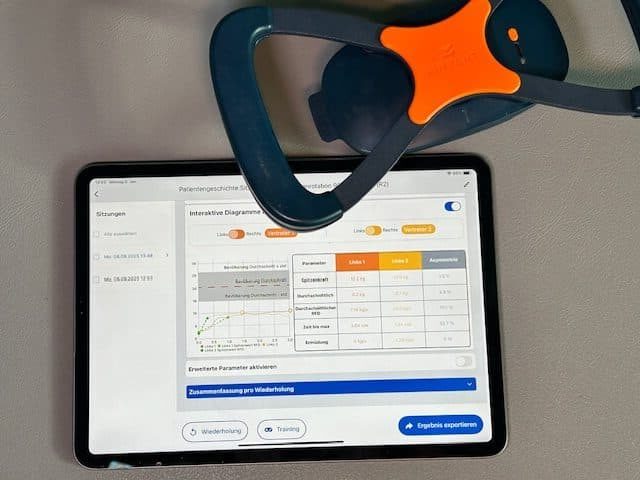
1. digital force measurement (Kinvent) Does your leg feel strong? That’s not enough for us. We measure it to the gram.
-
Focus on hamstrings: Many people only train the thigh extensors (quadriceps). But for the stability of the knee - especially the cruciate ligament strong hamstrings (the back of the thighs) is crucial. They are the active protective shield of your anterior cruciate ligament. We want to see that this ratio is correct.
2. the quality of the movement (Single Leg Squat) Power is useless without control. We leave you in charge. one-legged squat make.
-
The criterion: We’re not looking at how deep you go, but whether you keep the axis straight. Does your knee move inwards? Are you deviating from the midline? Any wobbling or deviation is a warning sign of unstable ligaments or weak hip muscles.
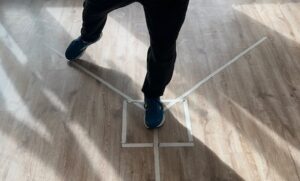
3. dynamics & frequency: the 40 cm jump test A single jump is not enough to prove your fitness for sports. In the game, you must react quickly again and again. That’s why we test your Reactive strength and endurance.
-
The test: They jump over a fixed distance of 40 cm back and forth - namely as often as possible.

-
The comparison: We count the clean landings and compare the number directly with yours. healthy leg. Do you perform significantly fewer repetitions with the operated leg or tire out more quickly? Then the risk is still too high. We want to see that you not only manage the distance, but that you do so at a high frequency and in a stable manner.
The Neuro factorDoes your brain still fear?
That’s our specialty at Physio Waidfuss. Often the muscle is ready, but the head isn’t (kinesophobia). If your brain doesn’t trust the knee 100% %, it tightens the protective muscles milliseconds too late. The joint is briefly unprotected. Our test battery addresses these invisible fears.
Typical symptoms that indicate a premature return to training
- Persistent swelling or pain after exertion
- Significant difference in strength or stability between the injured and healthy side
- Uncertainty or fear when performing sports-specific movements
Conclusion: Your comeback needs security
Don't go back to sport to get fit. Get fit to go back to sport.
When you return to sports, don’t rely on the calendar. If you want to be sure that your knee really holds up – without swelling, with full extension, and stable hamstrings – then come by.
With Physio Waidfuss in Zurich We’ll test you to the fullest extent. So that you not only return stronger than before.
Do you want to know where you stand? Talk to your physiotherapist here in Wipkingen.
Self-help: This is how you prepare yourself for a return to work
-
Increase load gradually: Never increase the length or intensity of your training by more than about 10% per week.
-
Watch for swelling: Keep a short diary – does the knee subside after exertion, or does it remain swollen?
-
Testing on both sides: Regularly compare strength and jumping ability with your healthy leg, for example by performing one-legged knee bends in front of a mirror.
-
Take warm-up seriously: A structured, activating warm-up program before every training session significantly reduces the risk of relapse.
When should you have it checked before re-entering?
Move back to sports and have yourself examined by a doctor or physical therapist if:
-
the knee after strain re-swelling or feels warm.
-
You are one Feeling of instability or notice a "slight turn".
-
There remains a significant difference in the jumping or strength tests from the healthy leg.
-
Pain during or after training increases instead of decreasing.
Our Sports Physiotherapy It guides you through the entire return-to-sport process with individual return-to-sport tests – from the first load up to the competition.
Book an appointment online now for a Return-to-Sport test
After an accident? Information on the cost coverage by the Accident Insurance (UVG) and on the course of therapy can be found on our page. Physiotherapy after an accident in Zurich.

Frozen Shoulder: When the shoulder freezes and the nights become agony
Frozen Shoulder: When the shoulder freezes and nights become a torment. Do you feel like your arm is stuck?…
Read more
Acute lumbago sciatica Zurich – We treat you in Wipkingen
Back spasm and sciatica: When your back suddenly locks Up. A wrong step while getting out of the trampoline,...
Read more
ACL Tear Rehab in Zurich | Waidfuss Physiotherapy
Cruciate Ligament Tear Rehab Zurich: How to Regain Stability and Confidence An unfortunate change of direction during...
Read more
Impingement Syndrome: When Your Shoulder Gets Pinched – Causes and Solutions
A quick reach for the coffee cup on the top shelf or putting on your jacket in the morning – and suddenly…
Read more