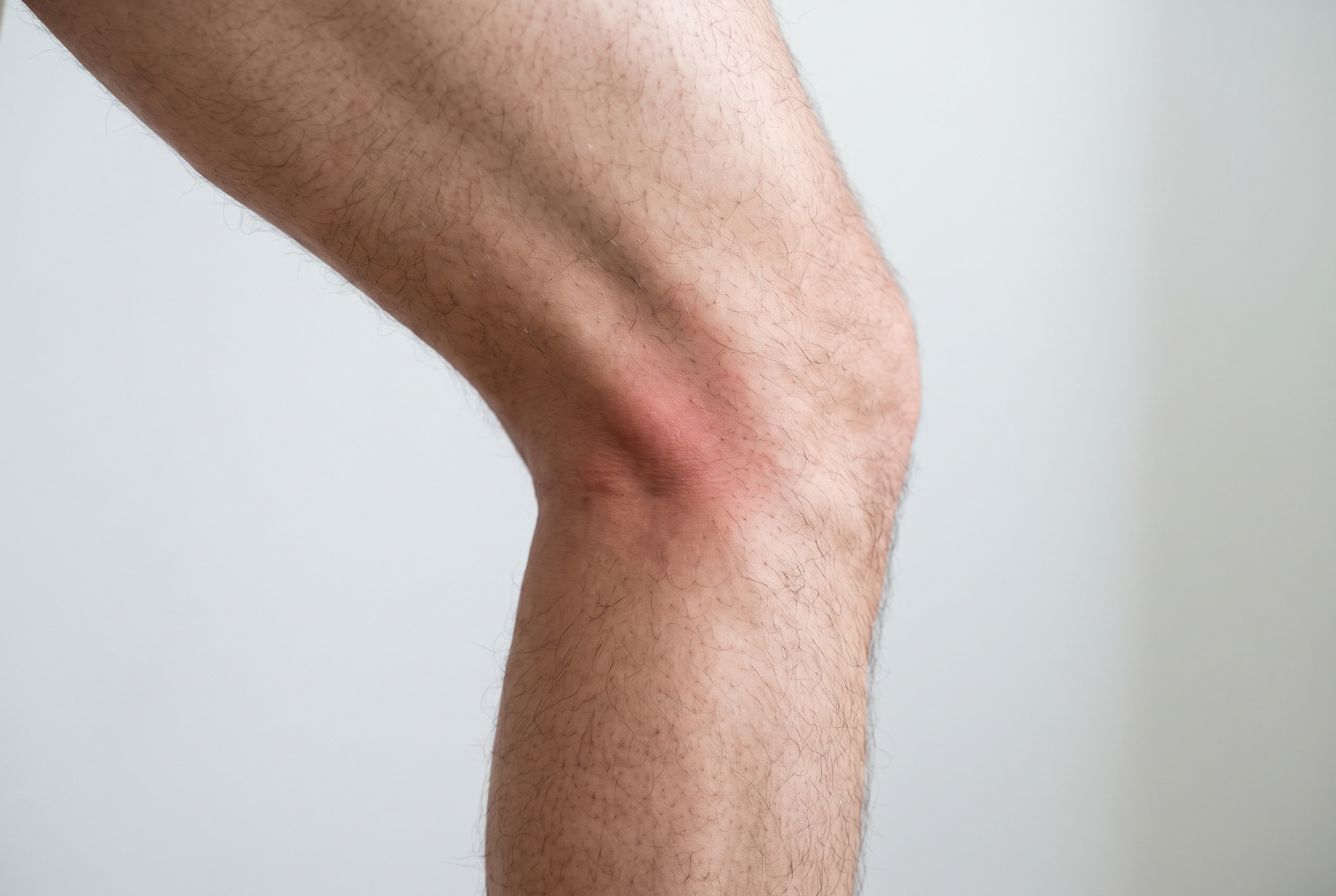
What is a Baker cyst?
There is a small sac of fluid located in the knee joint. When the joint is irritated, the sac produces more synovial fluid, which can accumulate in the sac and form a bulge. This is the Baker cyst, also known as the knee joint cyst. It is therefore not usually the cause of the symptoms, but rather a consequence of them.
Typical symptoms
- Soft, sometimes bulging swelling in the groin area
- Pressure and tension sensation, especially when bending or stretching fully
- Complaints often increase after exertion
- Sometimes radiating into the calf
- With small cysts, symptoms often go unnoticed.
Important: Differentiation from thrombosis
A swollen, painful calf can also be caused by a blood clot in a leg vein (thrombosis). This is an emergency. Seek medical attention on the same day if the calf or leg suddenly becomes thick, red, warm, or tender to the touch. If you experience shortness of breath or chest pain, call 144 immediately. A Baker cyst can also rupture. Then suddenly, pain and swelling in the calf may occur, resembling a thrombosis (Hasan et al., 2025; Orthopedics-Review, 2014). Therefore, a doctor or a nurse always resolves swelling of the calves.
Causes: What lies behind the knee
Common triggers are meniscus damage, cartilage wear (arthrosis), ligament injuries, or inflammation after overexertion. Read more about this topic here. Meniscus injury, Osteoarthritis and Knee pain. Therefore, the treatment is not only based on the cyst itself, but also on the cause of the joint inflammation.
Current studies also show that a Baker cyst is often associated with knee osteoarthritis, meniscus injury, or rheumatic joint disease (Hasan et al., 2025; Abate et al., 2021).
Diagnosis
The cyst can usually be felt well. The ultrasound reliably shows it and distinguishes it from other swellings. An MRI can show which change in the knee causes the cyst. The imaging is ordered by doctors.
What you can do yourself
- Do not overexert the knee, but keep moving: gentle walking, cycling without much resistance.
- It temporarily cools down irritation.
- Avoid deep squats, kneeling, and prolonged exertion on hard ground for the time being.
- Do not tightly bandage the knee. A too tight bandage can hinder the return of blood flow.
How does physiotherapy help?
We thoroughly examine the knee: mobility, stability, muscle strength, and gait pattern. Then we treat the underlying cause. This includes: Manual therapy, Mobilization of the joint, strengthening of the thighs and hips, and an exercise program that relieves the knee. Often, the cyst will subside when the irritation in the joint subsides. If it remains large or painful, doctors will discuss a puncture, infiltration, or, rarely, an operation with you.
Physiotherapy is referred to in overview studies as part of conservative treatment. Complaints may return after conservative treatment (Hasan et al., 2025).
After an infiltration puncture, the cyst can recur if a meniscus injury is not treated (Hasan et al., 2025Therefore, the examination of the knee joint is part of the treatment.
A small case series involving nine individuals describes, after an ultrasound-guided puncture with a cortisone injection, an average of about six months less pain. Due to the small number, the statement is limited in its significance (Stroiescu et al., 2023).
When to see a doctor?
- Suddenly thick, red, warm or very painful calves: on the same day, emergency call 144 due to shortness of breath
- Sudden stabbing pain behind the knee with swelling
- The knee locks or gives way
- The swelling grows or remains for weeks
Frequently asked questions
Is a Baker cyst dangerous?
Most often not. However, it can burst, and the swelling of the vein must always be attributed to a thrombosis.
Does a Baker cyst disappear on its own?
This can happen, especially if the cause in the knee subsides. If the irritation persists, it often returns.
In a study involving 130 people with knee osteoarthritis, the symptoms improved after three months of conservative treatment, even in people with Baker’s cyst. After six months, the effect was gone (Abate et al., 2021).
May I practice sports with a Bakerzyste?
Most often in adapted form. Joint-gentle exercise is helpful; we discuss hard impact and rotational loads with you.
Date in Zürich Wipkingen and Höngg
Do you have swelling in your groin? We will examine your knee and look for the cause. Book appointment online or by phone at 044 585 99 49.
This article does not replace medical advice.