

The tractus syndrome - treating runner's knee
The Tractus Syndrome: When the knee burns even though it is healthy
A runner's knee is an overuse of the broad tendon plate (iliotibial tract) that runs from the hip down the outside of the thigh to just below the knee joint.
When jogging, your knee bends and straightens thousands of times. In the process, this tendinous plate repeatedly slides over the outer bony prominence of the knee joint. If the tension is too high, the structure rubs over an edge like a taut rope. The result is a painful irritation of the tissue.
Typical symptoms of runner’s knee
- Pain that is sharp or burning on the outside of the knee, usually only after a certain distance has been covered
- Pain increases downhill or when climbing stairs
- Initially, the pain disappears completely at rest, but later it can persist even when walking.
The pain is in the knee, the cause often somewhere else entirely
Many patients wonder why ointments or local cooling often do not provide lasting relief. This is because the knee is often just the weakest link in a long chain of cause and effect within our body. In the Physiotherapy Waidfuss therefore, let us never look only at the painful area, but rather at the entire posture:
-
The weak hip: The most common cause is a gluteus medius muscle that is too weak (Gluteus medius muscle). If this fails during stabilization, the pelvis tilts when walking. The knee collapses inward, and the tension on the outer tendon plate increases massively.

-
The foundation (feet): If your feet roll inward too much (overpronation), the entire leg rotates. Here, too, the tension on the outer knee increases.
-
The torso and neck: Even tense neck or shoulder muscles at the desk can be a trigger! A rigid shoulder girdle blocks the natural swinging movement of the arms when running. The torso has to compensate for this lack of rotation, which is ultimately transmitted via the pelvis down to the knees, overloading them.

The Role of the Brain: Neurocentric Training for Runner's Knee
Pain always originates in the head. It is a warning signal from our nervous system. This is precisely where modern neurocentric training (neuroathletics) that we integrate into our treatments.
Our brain controls every movement based on the information it receives from the body. If old injuries (e.g., a twisted ankle years ago) have impaired the sensors in the tissue, the brain receives unclear signals. The reaction? The nervous system feels unsafe and protectively increases muscle tension – often precisely in the area of the outer thigh and hip muscles. Through targeted neuronal stimuli, we can dial down this „protective tension“ in the brain again, causing the tissue to relax immediately.
Self-help: What you can do immediately
To calm the nervous system and address the causes, you can start with simple routines right at home. Incorporate these Everyday practical tips into your day:
-
The sensory foot wake-up call (neuro tip): Before you head out or get up in the morning, vigorously rub the soles of your feet for 30 seconds with a rough towel or a massage ball. This awakens the receptors in the foot, provides the brain with a crystal-clear image of your foundation, and reflexively reduces the protective tension in the outer thigh.
-
The „pelvic scale“ while brushing teeth: Stand on one leg while brushing your teeth. Pay conscious attention to keeping your pelvis exactly level on both sides and not „sinking“ into your standing hip. This specifically exercises the gluteal muscle that stabilizes your knee while running.
Treatment approaches in our practice
Should the knee continue to act up, we will help you with a precisely biomechanical and functional analysis. Our therapy components include, among other things:
-
Strengthening and motor learning: Targeted training of the pelvic and core muscles to restore axial stability.
-
Gentle fascia and tissue work: Manual techniques for tension regulation of the affected structures.
-
Dry needling: In stubborn cases, we additionally and very cautiously use dry needling. This involves muscular hardening (Trigger points) precisely and effectively relaxed in the hip muscles using ultra-fine needles to take the tension off the knee.
-
Taping the knee: Taping systems can temporarily give the nervous system a greater sense of security and support healing under stress.
When should you have a medical or physical therapy consultation?
Have the knee examined promptly if the pain occurs even when walking or at rest, the knee becomes swollen or feels unstable, or the symptoms do not improve despite a training break of several weeks.
When can I go jogging again?
An absolute running ban is rarely necessary, but intelligent training management is essential. Reduce the volume to the point where you remain pain-free. Shorter distances, a higher cadence (smaller steps), or temporarily switching to cycling to maintain endurance often help.
Stop running with pain! Whether jogging in the Käferberg forest or after a long day at the desk: We help you find the true cause of your knee pain. Contact the team at Physiotherapy Waidfuss – we look forward to accompanying you holistically on your journey back to pain-free movement at our practice in the greater Zurich area (Wipkingen/Höngg)! Book an appointment online now

Knee joint broken: healing, rehabilitation and physiotherapy
How to recognize a knee fracture, how long the healing process takes and how physiotherapy can help your knee recover…
Read more
Meniscus injury: When the shock absorber in the knee fails
Meniscus injury: When the shock absorber in the knee fails A sudden pulling when turning, a crack in the knee…
Read more
Sharp pain while jogging? How to get the runner's knee (iliotibial band syndrome) under control
The temperatures are rising, the running shoes are laced up, and the first few kilometers along the Limmat are running as if by themselves.…
Read more
After the cruciate ligament rupture: The way back to sport in Zurich
Your path back to sports after a torn ligament: One wrong step, one abrupt turn, a cracking sound...
Read more
Knee injury after accident what to do?
Following an accident resulting in a knee or leg injury – whether a ligament tear, meniscus tear, or fracture – we accompany you...
Read more
Hamstring injury: symptoms, rehabilitation and prevention
Hamstring injuries usually start suddenly: a stabbing pain in the back of the thigh, often…
Read more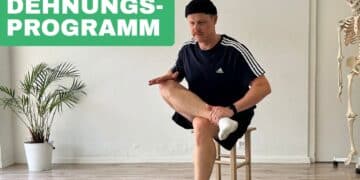
Stretching program
Your stretching program Stretching is an essential foundation for your mobility and well-being.
Read more
Bursitis of the knee: causes, symptoms and treatment options
What is knee bursitis? Bursitis, also known as...
Read more