
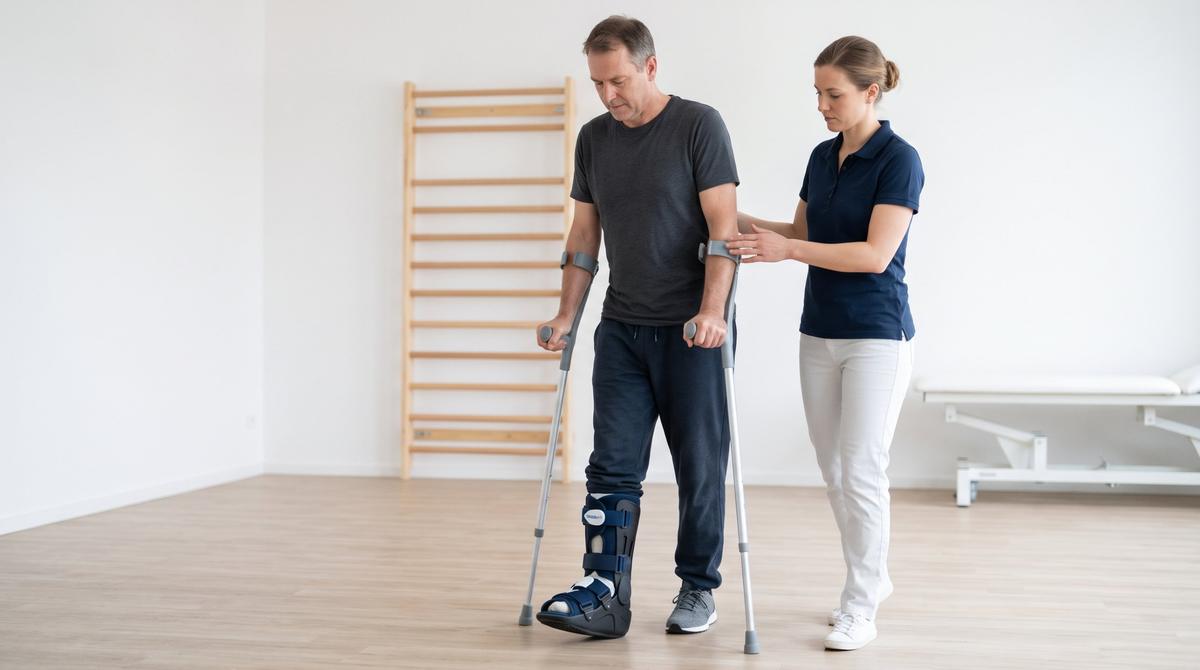
A wrong step on the stairs, a dispute while jogging, or a fall while skiing: Who is at risk? Ankle broken has suddenly become dependent on crutches. Most often the upper ankle is affected, more specifically one or more of the ankles at the end of the shin and calf bones. Specialists then speak of a sprained ankle or ankle fracture.
After plastering or surgery, mobility, strength, and balance are significantly limited. With targeted physiotherapy, you will learn to walk safely again and fully load your ankle. In our clinic in Zürich-Wipkingen, we guide you from the first steps on crutches to returning to everyday life and sports.
Symptoms: Fracture or sprain?
A broken ankle and a severe sprain feel similar at first. Signs of a fracture include:
- They can hardly or not at all bear weight on their foot and cannot walk for more than four steps.
- strong pressure pain directly on the ankle bone
- rapid, pronounced swelling and bleeding
- visible misalignment of the foot
If only the tape recorder is affected, read more in our articles. Sprain of the ankle and ligament tear and Sprained foot. However, only an X-ray image can determine whether there is a fracture.
When should you see a doctor?
If you are unable to walk after an accident or if your ankle has an abnormal position, go immediately to the doctor or to the emergency room. An untreated fracture can heal incorrectly and later lead to arthritis in the ankle joint.
Immediately report to your doctor if you experience any of the following during your recovery:
- the leg suddenly swells, becomes warm or hurts (possible sign of a thrombosis)
- If you suddenly experience shortness of breath or chest pain – then call the emergency number 144
- the toes become numb, cold or blue
- the surgical scar is red, it is moist or you get fever
How long does the healing process take if the ankle is broken?
A stable fracture without displacement is usually treated with plaster or a special shoe (orthosis). In cases of displaced or unstable fractures, surgery is usually performed and the bone is fixed with plates and screws.
In both cases, you may initially only be able to load your foot partially, that is, with crutches. Your doctor will determine how much and for how long. The bone usually takes about six weeks to become fully loadable again. It often takes several months before you can walk, jog, or do sports again without limping. For more information about the timing of this process, read the article. Wound healing phases.
Self-help: What you can do yourself
If the ankle joint is broken, you can contribute a lot to the healing with these measures:
- Elevate: During the first few weeks, keep the leg elevated often, preferably above the height of the knee. This reduces swelling.
- Moving toes and knees: Move your toes, knees, and hips several times a day. This keeps the muscles active and promotes blood circulation.
- Maintain the load: Stick to the allowed load exactly. Too much too soon can disrupt healing; too little delays it.
- Thrombosis protection: Follow the thromboprophylaxis prescribed by your doctor consistently.
- Sure you're going: Remove tripping hazards at home and practice climbing stairs on a stool first with supervision.
Treatment in Physiotherapy
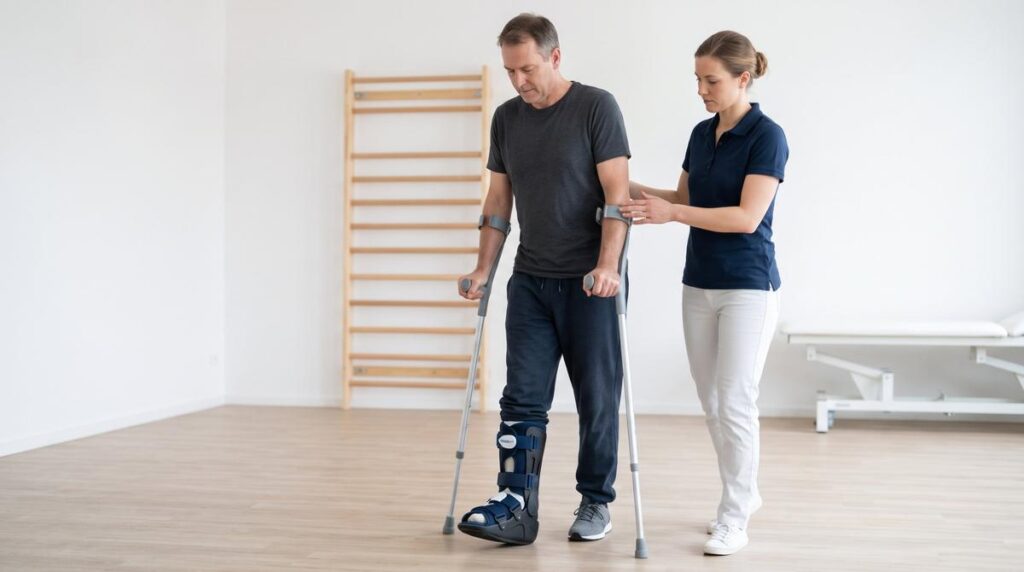
Depending on the treatment, physiotherapy begins during the plaster or splint phase or shortly after the operation. At the beginning, we examine your gait pattern, mobility, swelling, and strength. We then build your therapy plan based on these findings:
- Walking on sticks: We will practice with you the proper way to walk with partial load and how to climb stairs.
- Reduce swelling: with manual lymphatic drainage and targeted exercise routines
- Improve mobility: with manual therapy and mobilization of the ankle and foot
- Getting active early: On our Special exercise bike With an adjustable crank, you can start training gently early on.
- Strength and balance: We specifically train leg strength, foot muscles, and balance, for example in our Functional Training Area. With the Power measurement Let's compare the injured side with the healthy side.
- Back to the sport: Before you start jogging or jumping again, we will assess your fitness level using a Return-to-Sport Test.
Ankle broken: Who pays for the physiotherapy?
For physiotherapy, you need a medical prescription. An accident or fall is considered an accident. If you are accident-insured through your employer, the accident insurance usually covers the prescribed physiotherapy in full, without a deductible or co-payment. We directly settle with the insurance company. All details can be found on our page. Physiotherapy after an accident in Zurich.
If you are unable to reach the practice during the first few weeks, we can also come to your home in the area of Wipkingen and Höngg: Mobile physiotherapy.
Frequently asked questions about broken ankles
How long do I have to walk on sticks?
It depends on the type of fracture and the treatment. Often it takes a few weeks. Your doctor will decide when you can start to load more weight. We will help you gradually wean yourself off the crutches.
Why am I still lagging behind after the cast?
After the immobilization period, there is a lack of mobility in the ankle joint and strength in the calf. The brain also has to learn the normal gait pattern anew. With targeted training, limping usually disappears gradually.
Do the plate and screws need to be removed again?
Not always. Whether and when the metal is removed is up to your surgeon.
Make an appointment
Has your ankle been broken and are you looking for physiotherapy near you? We will support you from the very first steps onwards.
Our practice is located at Hönggerstrasse 118 in Zürich-Wipkingen, directly at the Waidfussweg tram stop (tram 50). Two parking spaces are available directly in front of the practice. Bring your medical prescription to the first appointment and, in the event of an accident, bring the damage number of your insurance company with you. Call us at 044 585 99 49 or Book your appointment online.
