
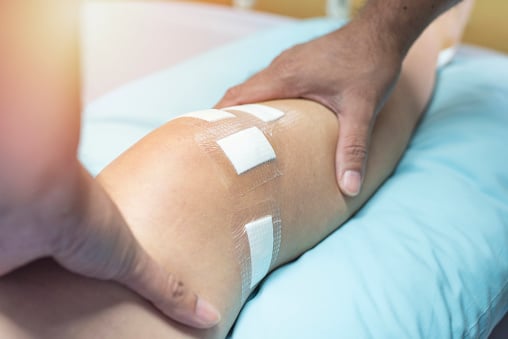


Manual Lymphatic Drainage: Actively Support Wound Healing
Following a procedure, the tissue inevitably reacts with severe swelling (edema). Wound fluid accumulates in the surgical area, which not only causes tension and pain, but can also block the natural healing process.
Through the gentle, rhythmically pumping technique of manual lymphatic drainage let us specifically stimulate the removal of this accumulated fluid and inflammatory metabolic waste via the lymphatic system. This often noticeably relieves the tissue after the first treatment. The improved circulation also optimally supplies the surgical area with fresh nutrients, which Significantly Accelerated Wound Healing and relieves the painful pressure on the joint.
Typical symptoms after an operation
After an operative procedure, swelling, limited mobility, scar tension, and noticeable weakness in the affected area are completely normal side effects. Often, compensatory movements and bracing are also present, which, untreated, can affect adjacent joints and the muscles.
The holistic picture: Why we don't just look at the scar
If you have had knee surgery, the focus is naturally on this joint. However, your body functions like a highly complex clockwork mechanism. Just a few days after surgery, you automatically begin to protect the operated area. This compensatory posture forces other regions of the body to perform at their maximum.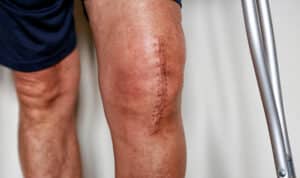
Suddenly, the Lower back (trunk) the burden of the uneven gait, or the opposite Hip and the Shoulders They become extremely tense due to the change in biomechanics. Successful rehabilitation therefore always involves the entire body.
We mobilize your spine, strengthen your core muscles, and release deep tension in the Neck, so that you don't leave therapy with new issues to deal with. Learn more about our holistic methods on our Overview of Services Offered by Waidfuss Physical Therapy.
The nervous system: Overcoming the brain's fear of movement
After surgery, the tissue sends an alarm signal to the brain. The nervous system responds with a drastic protective mechanism: It reduces strength in the affected area, limits the range of motion, and sends pain signals to prevent you from making careless movements.
Here, we incorporate the principles of the neuro-focused training (neuroathletics) into your rehabilitation. When we use targeted sensory stimuli to show the brain that a movement is safe again, the nervous system releases the proverbial “handbrake.” The result: The muscles can be controlled more effectively again, and the healing process is significantly accelerated because the brain and body are working together once more.
Targeted relaxation for compensatory tissue
Because patients often adopt a protective posture for weeks after surgery, adjacent muscle groups and fascia can become extremely stiff. When deep tension hinders rehabilitation progress, we use targeted relaxation techniques.
Gentle, manual techniques or—after a thorough explanation and consultation—precise, minimally invasive methods such as the Dry needling or the Trigger Point Therapy can help here. These techniques are used in a purely objective manner to precisely promote blood circulation in the adhered tissue and relieve the body of the burden of compensation.
Self-help: Everyday practical tips for a safe start
To support you at home right from the very first days, we have put together simple yet extremely effective exercises for a safe daily routine:
-
The "Torso Anchor" before getting out of bed: Before getting out of bed after leg or hip surgery, engage your core. Gently tighten your abdominal muscles (pull your belly button slightly inward) and press your hands flat against the mattress. This stabilizes your core and greatly reduces the strain on your legs as you take your first steps.
-
Sensory scar tapping: Once the wound is completely cleared by the doctor, gently and rhythmically tap around the scar area with two fingers. This awakens the delicate receptors in the skin and signals to your nervous system that this region is safe to touch.
When should you see a doctor or go to physical therapy?
Immediately seek medical advice if the surgical scar becomes severely red, hot or dry, fever occurs, or the pain increases instead of decreasing in line with the expected healing process.
After leaving the hospital: Aftercare near you
Many of our patients come to us after an operation at Stadtspital Waid, Stadtspital Triemli, Schulthess Klinik, University Hospital Zurich (USZ), or University Clinic Balgrist. After leaving the hospital, most people seek a practice near their home – our practice at Hönggerstrasse 118 is ideally located for Wipkingen, Höngg, and the surrounding neighborhoods. We treat according to the guidelines of your surgeon or surgeon, based on the surgical and discharge report, and, if necessary, we directly consult with the hospital or your family doctor.
It is best to register as soon as you know your date of departure – we will try to give you an initial appointment as soon as possible. Bring the medical prescription, the departure or surgical report, and your insurance card to the first appointment.
For family members
Are you organizing therapy for your mother, father, or partner? Just give us a call at 044 585 99 49. We clarify over the phone which documents are needed and find suitable dates.
How to get there: Tram 50 and parking right in front of the practice
You can reach us by tram 50, stop Waidfussweg – right outside the door. Those arriving by car can use one of the two marked parking spaces directly in front of the entrance. This is particularly convenient in the first weeks after an operation, when you’re still using crutches.
Frequently Asked Questions About Postoperative Physical Therapy (FAQ)
1. When should I start physical therapy in Wipkingen after surgery?
As a rule: As early as possible, often within the first few days after hospital discharge. Please strictly follow your surgeon's instructions. The earlier we start with lymphatic drainage and gentle mobilization, the fewer painful adhesions and compensatory postures will develop in your body.
2. How do I get to the Waidfuss practice in Höngg/Wipkingen if I'm still using crutches?
Our practice has excellent public transport connections in Zurich and is designed so that you can reach us completely safely, without steps, and easily, even with walking aids.
3. My doctor has prescribed "functional gait training" for me. How does that work at your practice?
We train with you for safe walking under realistic conditions, far away from rigid equipment. With targeted balance exercises, unstable surfaces such as proprioception mats, and dynamic steps in the room, we perfectly prepare your nervous system for the uneven sidewalks and small inclines of everyday life in Zurich.
4. Does Swiss basic health insurance cover the costs of my rehabilitation?
Yes. If your attending physician or hospital doctor issues you a medical prescription for physical therapy after the procedure, the costs for the treatments—minus your deductible and coinsurance—will be covered by your basic health insurance or accident insurance.
5. Can physical therapy also help with pain caused by the surgical scar?
Definitely. Scar tissue can adhere to deep fascial layers and thus massively restrict the mobility of the knee, shoulder, or torso. Through special manual scar mobilization, we make the tissue soft, elastic, and pain-free again.
Physiotherapy after surgery Zurich: Your safe path back to everyday life
Surgery is only the first step to recovery – the real work begins afterwards. In Physiotherapy Waidfuss we won't leave you alone with this challenge. We combine traditional rehabilitation measures with modern neurocentric approaches, decongestant lymphatic drainage, and a holistic view of your entire body.
If you are in the room Zurich, Wipkingen, or Höngg If you're at home and looking for a qualified partner for your postoperative rehabilitation, we're here for you.
After an accident? Information on the cost coverage by the Accident Insurance (UVG) and on the course of therapy can be found on our page. Physiotherapy after an accident in Zurich.

Spinal canal stenosis: When walking suddenly becomes a torture
What is a spinal canal stenosis? It is a gradual process that severely restricts everyday life: they make you…
Read more
Neck pain and headaches: The way out of the home office trap
Neck pain and headaches The gaze is fixed on the screen, the shoulders move involuntarily…
Read more
Back pain during pregnancy in Zurich | Physio Waidfuss
Back pain during pregnancy: This is how physiotherapy in Wipkingen can help you…
Read more
Storage dizziness (BPLS): Vestibular physiotherapy in cases of dizziness attacks
The room rotates even though you lie completely still. They rotate in the bed, and for a few seconds everything…
Read more
Meniscus injury: When the shock absorber in the knee fails
Meniscus injury: When the shock absorber in the knee fails A sudden pulling when turning, a crack in the knee…
Read more
Shoulder dislocation: When the shoulder jumps out of the joint
Shoulder dislocation: When the shoulder jumps out of the joint: A fall onto the outstretched arm or onto the shoulder,...
Read more
Neck and shoulder pain
Author: Philipp Schröder, physiotherapist | Updated on: 09/16/2026 Zurich Wipkingen Pain in the neck-shoulder transition…
Read more
Sharp pain while jogging? How to get the runner's knee (iliotibial band syndrome) under control
The temperatures are rising, the running shoes are laced up, and the first few kilometers along the Limmat are running as if by themselves.…
Read more