


The knee as the "joint in the middle"
Purely biomechanically speaking the knee a so-called hinge joint, which is located precisely between two highly mobile zones: the ankle and the hip. Often, the knee is not the only culprit in cases of knee pain.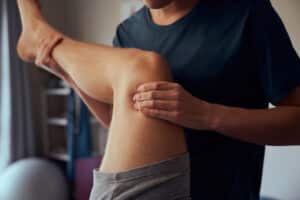
For example, if there is a lack of mobility in the knee joint or the hip muscles are weakened, the knee must compensate for these deficiencies. A weak core musculature also leads to a changed static balance that affects the knee joints like a red thread. Therefore, when we treat knee pain, we also include the hips, core and feet in the examination.
Typical symptoms of knee pain
Knee pain can manifest itself in many different ways: as a stabbing pain when climbing stairs, as a dull pulling sensation after prolonged sitting, as swelling after exertion, or as a feeling of instability when walking. Often, the discomfort initially only occurs with certain movements and only gradually increases over time.
The Nervous System: The Conductor of Pain
Pain always originates in the brain. It is a warning signal from our nervous system that wants to protect us. This is precisely where the neurocentric training (neuroathletics). If certain brain areas receive inaccurate or incomplete information from the joints, the system feels "uncertain.".
The consequence: The brain throttles performance, reflexively increases muscle tension, and sends pain signals. In therapy, we therefore work not only on muscles and fascia, but also specifically train the nervous system. Through specific stimuli, we improve the quality of the data that the brain processes—movements become safe, fluid, and pain-free again.
Gentle techniques for stubborn tension
Often, adhered fascia and deep muscular tension play a significant role in knee problems. In this context, techniques such as classical Trigger Point Therapy or that Dry needling be used.
These methods aim to resolve local hardening in muscle tissue precisely and efficiently. We always employ such techniques in a clear, discreet manner and only after careful consultation, in addition to active training.
Knee pain physiotherapy Zurich: What the studies show
Knee pain has many causes. For the most common ones, there are now clear recommendations from research:
- Pain in the front of the knee (patellofemoral pain syndrome): The international consensus of Collins et al. 2018 Recommends training as the most important treatment, preferably a combination of hip and knee strengthening exercises. A meta-analysis with 14 studies (Nascimento et al. 2018) confirmed: Hip and knee strength exercises relieve knee pain better than knee strength exercises alone. Manual therapy or electrotherapy alone are not recommended, however.
- Knee osteoarthritis: According to the Cochrane review Lawford et al. 2024 With 139 studies, training improves pain and function, but only moderately on average. In a Danish study (Skou et al. 2015) postponed the operation for two of the three people who were already eligible for a new knee joint by at least two years thanks to a training program.
- Damage to the meniscus: In a study in the New England Journal of Medicine, arthroscopy was not better than sham surgery for degenerative meniscus tears (Sihvonen et al. 2013Physiotherapy is therefore usually the first step here.
For our knee pain physiotherapy in Zurich, this means: Targeted strength training is the foundation. We additionally use neurocentric training and trigger point therapy, as there are significantly fewer studies available for them regarding knee pain.
Self-help: Two exercises for everyday life
To give you something right away, here are two simple exercises that you can easily incorporate into your daily routine:
-
The sensory wake-up call for the nervous system: Take a small, hard ball (e.g., a golf ball or hedgehog ball) and gently roll it on your foot in a standing or sitting position. This stimulates the receptors in your foot, sending clear signals to the brain and feeling very relaxing and pleasant for many people.
-
Hip activation while brushing teeth: Get on one leg (with the knee slightly bent). Now circle your pelvis slowly in both directions. This trains the core and hip stability; studies show that targeted hip strengthening helps with knee pain in the front of the knee joint (see below).
When should you see a doctor or go to physical therapy?
Seek prompt medical evaluation if the knee swells severely or becomes unstable after an accident, becomes blocked, or the pain persists despite rest for several weeks.
Frequently Asked Questions about Knee Pain (FAQ)
1. Why does my knee hurt especially when walking stairs in everyday life in Zurich?
When climbing stairs, many times the weight of your own body is applied to the kneecap. Often, the tissue around the kneecap is temporarily overloaded. According to studies, targeted strengthening exercises for the hips and thighs are then most effective.
2. How quickly can I get an appointment at Physiotherapie Waidfuss in Zurich?
We strive to offer patients from the Wipkingen and Höngg neighborhoods and the surrounding area an appointment as promptly as possible – especially in cases of acute pain. The best way to contact us is directly by phone or via our website.
3. Does physical therapy also help with chronic knee pain (e.g. Osteoarthritis)?
Yes, absolutely. Yes. For knee osteoarthritis, exercise is the recommended basic treatment. According to the large Cochrane review, the effects are rather moderate, so it is worth continuing for the long term. More about this in our article. Physical therapy for osteoarthritis.
4. Can I go for a walk at Hönggerberg despite having knee pain?
Movement is important, but it should be pain-free. Start with short walks on a flat surface. If the pain increases, take a break and discuss the ideal load management at your next therapy appointment.
5. Does basic health insurance cover the cost of therapy in Wipkingen?
If you have a medical prescription for physiotherapy, the costs are covered by mandatory Swiss health insurance (basic insurance) or accident insurance.
Knee pain physical therapy Zurich: Your path to freedom from pain
Knee pain don't need to restrict permanently. In the Physiotherapy Waidfuss Let us examine your symptoms holistically and look for the true cause – from the foot and the hip to the nervous system.
If you live in the Zurich, Wipkingen, or Höngg area and finally want to enjoy your daily life pain-free and active again, we look forward to hearing from you. Schedule an appointment with us and let us work on your health together.
Sources
- Collins NJ et al. (2018): 2018 Consensus statement on exercise therapy and physical interventions (orthoses, taping and manual therapy) to treat patellofemoral pain. Br J Sports Med. PubMed
- Nascimento LR et al. (2018): Strengthening the hips and knees is more effective than knee strengthening alone for reducing pain and improving activity in individuals with patellofemoral pain. J Orthop Sports Phys Ther. PubMed
- Lawford BJ et al. (2024): Exercise for osteoarthritis of the knee. Cochrane Database Syst Rev. PubMed
- Skou ST et al. (2015): A Randomized, Controlled Trial of Total Knee Replacement. N Engl J Med. PubMed
- Sihvonen R et al. (2013): Arthroscopic partial meniscectomy versus sham surgery for a degenerative meniscal tear. N Engl J Med. PubMed

Baker's cyst: Symptoms, causes, and treatment
Tension and swelling in the groin? What lies behind a Baker cyst and what can help you?
Read more
Knee joint broken: healing, rehabilitation and physiotherapy
How to recognize a knee fracture, how long the healing process takes and how physiotherapy can help your knee recover…
Read more
Meniscus injury: When the shock absorber in the knee fails
Meniscus injury: When the shock absorber in the knee fails A sudden pulling when turning, a crack in the knee…
Read more
Sharp pain while jogging? How to get the runner's knee (iliotibial band syndrome) under control
The temperatures are rising, the running shoes are laced up, and the first few kilometers along the Limmat are running as if by themselves.…
Read more
After the cruciate ligament rupture: The way back to sport in Zurich
Your return to sports after a torn ligament Sports after a torn ligament is the most important goal for many…
Read more
Knee injury after accident what to do?
Following an accident resulting in a knee or leg injury – whether a ligament tear, meniscus tear, or fracture – we accompany you...
Read more
Hamstring injury: symptoms, rehabilitation and prevention
Hamstring injuries usually start suddenly: a stabbing pain in the back of the thigh, often…
Read more
Stretching program
Your stretching program Stretching is an essential foundation for your mobility and well-being.
Read more