



Possible consequences of untreated complaints
 If you ignore pain, you risk it becoming chronic. Tension can trigger headaches, impair sleep and concentration and radiate into the shoulders or arms. The sooner you take action, the quicker and more lasting the improvement will be. Precise diagnostics, active exercises and ergonomic adaptation of the workplace stop the downward spiral.
Our approach at Waidfuss Physiotherapy
We take the time to understand your situation and create an individual plan - evidence-based, practical and goal-oriented.
- Listen and understand: Complaints, triggers, goals and previous strategies are recorded in a structured manner.
- Root cause analysis: We look at posture, workplace design, movement habits and everyday stresses.
- Targeted treatment: Manual therapy, trigger point therapy (targeted pressure on painful muscle points), Functional movement theory and if necessary, tape for relief. The goal is to reduce pain, improve joint function, and increase freedom of movement.
- Prevention and adviceErgonomic tips, exercises suitable for everyday use and strategies for less stressful routines ensure long-term results.
The most common mistakes in the workplace and how to avoid them
- Turtle neckPosition the top edge of the monitor at eye level and gently tilt your chin back.

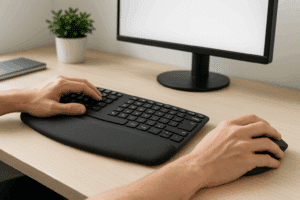
- Mouse shoulder: Hold the mouse close to your body and change hands regularly.
- Hump backSit upright, use the backrest and support the lumbar spine.
- Permanent seat trapStand up every 30 minutes, walk briefly, relax your shoulders and breathe deeply.
- Stress armor: Schedule short relaxation sequences several times a day to reduce muscle tone.
What the studies say about office back pain
The most important finding: Exercise and training help. A Cochrane review of 249 studies concluded with moderate certainty that exercise is likely to relieve pain in chronic back pain better than no treatment, standard care, or sham treatment (Hayden et al., 2021).
And what about the standing desk? Another Cochrane review showed that standing desks reduce the sitting time at work by an average of around 100 minutes per day in the short term, and by around 57 minutes after three to twelve months. However, the level of certainty is low, and whether a standing desk alone prevents back pain cannot be inferred from this (Shrestha et al., 2018).
For your office routine, that means: There is no perfect posture. Change your position often, include short breaks in your work, and exercise regularly. That brings more than just the «right» posture.
Sources
- Hayden J. A. et al. (2021): Exercise therapy for chronic low back pain. Cochrane Review. PubMed
- Shrestha N. et al. (2018): Workplace interventions for reducing sitting at work. Cochrane Review. PubMed
Self-help: Short exercises for when you need a break
- Neck Liberator: Tilt your head to your right shoulder, hold for 10-15 seconds, breathe calmly; change sides.
- Shoulder loosener: Slowly circle backwards ten times, then gently pull your shoulder blades together for 5 seconds.
- Back activator: Place your hands behind your head, lift your sternum, lean back slightly, inhale deeply; 5-8 repetitions.
- Hip opener while seated: Cross one leg over the other, gently tilt your upper body forward, hold for 15 seconds; change sides.
These exercises are simple, effective and can be carried out discreetly at the workplace. Regularity is key: short and frequent is better than infrequent and long.
Ergonomic working compact
- ScreenUpper edge at eye level, 50-70 cm distance, no glare from windows or lamps.
- Sitting: Feet fully on the floor, knees about 90 degrees, forearms parallel to the table top, use lumbar support.
- Keyboard and mouse: Keep your wrists neutral, place both at the same height, encourage side changes.
- Telephony: Use the headset to relieve the shoulder/neck area.
Pragmatically improving the home office
Many improvised workstations are not ideal. Small adjustments make a big difference: raise your laptop, use an external keyboard and mouse, provide sufficient light, plan clear work and break times and short active breaks. This creates healthy routines - even at home.
When should you contact us
- Pain that lasts longer than a week
- Headaches that originate in the neck
- Numbness or tingling in the hands or fingers
- Pain radiating into the arms
- Limited head mobility
- Sleep disorders due to pain
Early clarification clarifies causes, shortens treatment times and increases the chances of success.
Your path to freedom from pain
- Make an appointment
- Thorough initial assessment with findings
- Individual therapy plan, usually 9 sessions
- Guidance on exercises and everyday tips to stabilize results
Our focus is on active, evidence-based physiotherapy. You will learn what is good for your back - in the office, at home and in everyday life.
Costs and health insurance companies
In most cases, physiotherapy is covered by health insurance if it is prescribed by a doctor. We will be happy to assist you with questions about the prescription and the procedure. Investing in your health pays off twice over: less pain, more performance.
Prevention for the future
- Individual exercise programs for the workplace
- Ergonomics coaching for the office and home office
- Moving breaks with short mobility routines
- Stress reduction through breathing and relaxation techniques
It's worth sticking with it: continuity prevents relapses and strengthens your back and neck in the long term.
You can read about how we diagnose and treat back pain in our practice on the page. Physiotherapy for back pain in Zurich.
Contact and appointment
Physiotherapie Waidfuss, Hönggerstrasse 118, 8037 ZurichPhone 044 585 99 49E-mail info@physio-waidfuss.ch
Take the first step towards more freedom of movement and less pain today - we will provide you with professional, friendly and targeted support. Or book online here.

Trapped nerve: Symptoms, duration, and what really helps
Stinging, burning or tingling? What lies behind a pinched nerve, how long it takes and what really affects you...
Read text
Symphysis pain during pregnancy: What really helps?
Symphysis pain during pregnancy affects many women unexpectedly: a stabbing pain in the front of the thigh…
Read text
Spinal canal stenosis: When walking suddenly becomes a torture
What is a spinal canal stenosis? It is a gradual process that severely restricts everyday life: they make you…
Read text
Back pain during pregnancy in Zurich | Physio Waidfuss
Back pain during pregnancy: This is how physiotherapy in Wipkingen can help you…
Read text
Back pain due to sports Zurich | Physio Waidfuss
Back pain from sports: When training instead of balance brings stress to the back Zürich: They…
Read text
The SI Joint Syndrome: Is it the disc or the pelvis?
SI joint syndrome The pain is extremely deep, almost in the buttocks, often radiates unilaterally into the thigh and is...
Read text
Acute lumbago sciatica Zurich – We treat you in Wipkingen
Back spasm and sciatica: When your back suddenly locks Up. A wrong step while getting out of the trampoline,...
Read text
Back Pain in Old Age Zurich | Physio Waidfuss Wipkingen
Back pain in old age: Why it's not "normal aging" "It's just from aging" – we hear this sentence...
Read text
Diagnosis of herniated disc (disc hernia)
Diagnosis of herniated disc (disc herniation): What helps without surgery? For many patients, this is the moment when…
Read text
Lumbago or lumbago (witch's shot)? What is the difference?
Lumbago (Latin for «cross pain», colloquially also known as "hexenschuss") refers to sudden, often stabbing pain that occurs…
Read text
Put an end to office back pain in Zurich Wipkingen
Put an end to office back pain Do you know what it's like? A long working day, lots of screen time - your neck gets...
Read text
Stretching program
Your stretching program Stretching is an essential foundation for your mobility and well-being.
Read text
Workplace ergonomics - Do you work at a computer?
Ergonomics at the workplace: effective measures against back pain and neck tension You’re probably familiar with…
Read text
Back pain: understanding and solutions
Back pain: can have many causes Back pain is one of the most common complaints that affect people....
Read text
Lumbago - What really helps to relieve the pain
Lumbago - Understanding lower back pain: Important information for you Imagine you are lifting...
Read text
Piriformis syndrome - What helps against pain in the buttocks?
Piriformis syndrome and lumbago at a glance What is piriformis syndrome? Piriformis syndrome is a...
Read text
Back pain - causes, symptoms and treatment options
Back pain - causes, symptoms and treatment options Back pain is a widespread problem.
Read text