

Symptoms of patellar tendinopathy
A typical symptom of patellofemoral syndrome is a localized pain at the lower edge of the kneecap, where the patellar tendon attaches:
- Pain when jumping, landing, braking, climbing stairs, or bending down deeply
- Pain at the onset of training, which subsides during warm-up and then returns more severely afterwards
- Pain when pressing on the tip of the kneecap
- Pain after prolonged sitting with bent knees, for example in the cinema or in the car
Causes of patellofemoral syndrome
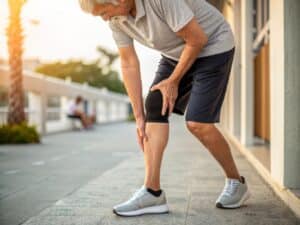
The patellar tendon connects the kneecap to the shinbone and transfers the force of the upper leg when you jump or land. If this load increases faster than the tendon can adapt, it becomes overloaded. Typical triggers are the start of the season, additional training, many jumps on hard ground, or insufficient recovery.
In the past, inflammation of the tendon was referred to as an injury. Today, specialists mostly use the term tendinopathy: it describes a painful overload of the tendon tissue. Therefore, the treatment focuses on targeted load building rather than simply resting.
What you can do yourself for patellofemoral syndrome
- Adjusting the load instead of completely stopping: First of all, reduce jumping and deep landings. Use a pain scale from 0 to 10: If the pain during sports is mild and is not worse the next day, the load is usually appropriate.
- Holding exercise: Sit with your back against the wall like an invisible chair and hold the position for 30 to 45 seconds, 4 to 5 times. Many find this to be a pain reliever.
- Building strength: Slow knee bends and steps down, later with additional weight. Slowly down, controlled ascent.
- Have patience: The tendons are slowly adapting. Expect several months before full jumping load is possible again.
Patella tendon syndrome: When to see a doctor?
Immediately, if you feel a sudden, severe pain while jumping or landing and cannot extend the leg actively afterwards. This may indicate a tear in the tendon.
You should also have it medically checked if:
- swelling of the entire knee, redness, overheating or fever
- Pain at rest or at night
- Pain under the kneecap in children and adolescents in growth
- No improvement after a few weeks with adjusted load
Treatment of patellofemoral syndrome in physiotherapy

What the studies show
In a randomized study involving 76 participants, a stepwise loading training, ranging from static exercises through slow strength training to jumping, was compared with a purely eccentric training (knee bends on a inclined board). After 24 weeks, the value for pain, function and sports ability improved by 28 points with the stepwise training, and by 18 points with the eccentric training. 43% returned to full sports activity compared to 27%; however, this difference was not clear-cut (Breda et al., 2021).
To be honest, the evidence for patellofemoral syndrome is generally weak. A 2025 review by Cochrane found only seven small studies involving 211 female athletes. Whether strength training works better than no treatment is very uncertain after that. Compared with a cortisone injection or surgery, there may have been little difference (Lopes et al., 2025).
We still rely on training: It’s low-risk, you can control it yourself, and the best single study to date supports a gradual approach.
This is how we proceed
- Investigation: We determine whether the patellar tendon is really the cause or whether the joint behind the kneecap is, and measure the leg force, for example with the Power measurement.
- Load plan: We determine how much training and how many jumps are appropriate at the moment.
- Gradual program: Stretching exercises, then slow, heavy strength training, then quick and explosive exercises, and finally sports-specific jumping. The next step follows when the previous one is well tolerated.
- In addition: Manual therapy and Dry needling for a tense thigh muscle, for example with Trigger point therapy according to IMTT, can relieve pressure in the short term.
For the journey back into competition, we use our Sports Physiotherapy. For pain that is more on the side or front of the knee, read our article on Inflammation of the synovial membrane in the knee.
Frequently asked questions about patellofemoral syndrome
Can I continue to exercise with patellofemoral syndrome?
Often yes, but with fewer bursts and controlled over the pain scale. In case of severe or increasing pain, pause the triggering activity and seek advice.
How long does the healing process take?
That’s very different. The Breda study involved 24 weeks of training. So plan months rather than weeks, and keep up with strength training after that as well.
Does a patellar tendon bandage help?
Some find a band under the kneecap during sports to be comfortable. However, the cause, an overloaded tendon, does not resolve it. Training remains crucial.
Does a syringe help?
In the Cochrane review, a cortisone injection compared with exercise at the end of treatment may have shown little difference in pain. The level of certainty is low. Always discuss injections with your doctor.
Sources
- Breda S. J. et al. (2021): Effectiveness of progressive tendon-loading exercise therapy in patients with patellar tendinopathy: a randomized clinical trial. British Journal of Sports Medicine. PubMed
- Lopes A. D. et al. (2025): Exercise for patellar tendinopathy. Cochrane Review. PubMed
Date in Zürich Wipkingen and Höngg
Does your knee hurt under the kneecap when you jump or climb stairs? We will examine your knee and build a training plan with you that will safely get you back into sports. Book appointment online or by phone at 044 585 99 49.
This article does not replace medical advice.

Baker's cyst: Symptoms, causes, and treatment
Tension and swelling in the groin? What lies behind a Baker cyst and what can help you?
Read more
Knee joint broken: healing, rehabilitation and physiotherapy
How to recognize a knee fracture, how long the healing process takes and how physiotherapy can help your knee recover…
Read more
Meniscus injury: When the shock absorber in the knee fails
Meniscus injury: When the shock absorber in the knee fails A sudden pulling when turning, a crack in the knee…
Read more
Sharp pain while jogging? How to get the runner's knee (iliotibial band syndrome) under control
The temperatures are rising, the running shoes are laced up, and the first few kilometers along the Limmat are running as if by themselves.…
Read more
After the cruciate ligament rupture: The way back to sport in Zurich
Your return to sports after a torn ligament Sports after a torn ligament is the most important goal for many…
Read more
Knee injury after accident what to do?
Following an accident resulting in a knee or leg injury – whether a ligament tear, meniscus tear, or fracture – we accompany you...
Read more
Hamstring injury: symptoms, rehabilitation and prevention
Hamstring injuries usually start suddenly: a stabbing pain in the back of the thigh, often…
Read more
Stretching program
Your stretching program Stretching is an essential foundation for your mobility and well-being.
Read more
Bursitis of the knee: causes, symptoms and treatment options
What is knee bursitis? Bursitis, also known as...
Read more
Patella tip syndrome
Patellar tendon syndrome: Pain under the kneecap The patellar tendon syndrome, also known as «Jumper's Knee» or patellar tendon tendinopathy…
Read more
Knee pain – Why it occurs and how you can relieve it
Everything you need to know about knee pain: Causes and treatment options Knee pain is a common...
Read more
Arthrosis – What you should know about the joint disease
What is osteoarthritis? Osteoarthritis is a widespread degenerative joint disease in which the cartilage of the joint and…
Read more
Flossing during scar treatment: What it can and cannot do
Have you ever heard of flossing? This innovative physiotherapy technique is becoming increasingly popular,...
Read more